

If you’ve spent any time around British people or British TV shows, you’ve probably heard someone described as “a good bloke.” It’s one of those words that sounds instantly familiar, even if you’re not entirely sure what it means or where it comes from.
In simple terms, bloke means “man” or “guy” in British English. It’s casual, friendly, and used constantly in everyday conversation across the UK, Ireland, Australia, New Zealand, and South Africa. This guide breaks down everything you need to know about the word — its meaning, origin, pronunciation, cultural weight, and how it’s used today, including on social media and in texting.
Bloke Meaning Overview
At its core, bloke is an informal noun for a man, especially an ordinary, average man. Think of it as the British equivalent of “average Joe” or “regular guy.”
Key facts about the word:
- Part of speech: Noun
- Meaning: A man, especially an ordinary or unremarkable one
- Register: Informal, colloquial, conversational
- Regions of use: UK, Ireland, Australia, New Zealand, South Africa
- Tone: Friendly, casual, often affectionate
You’ll almost always hear it in relaxed, spoken contexts rather than formal writing. Nobody writes “the bloke will attend the meeting” in a business email — but they might say it out loud to a colleague.
What Does Bloke Mean in Slang?
In slang usage, bloke simply refers to any man, but the tone around it carries extra meaning depending on context.
- “Some bloke stopped me on the street” = an unknown/random man
- “He’s a top bloke” = he’s a great guy
- “That bloke over there” = pointing out a man casually
It’s rarely used to describe someone with formality, wealth, or high status. Instead, it leans toward describing someone relatable, down-to-earth, and unpretentious.
Bloke Meaning in Text Messages
In texts, DMs, and casual chats, “bloke” keeps the same meaning but shows up in shortened, informal contexts:
- “Met a nice bloke at the gym today”
- “This bloke keeps texting me lol”
- “My bloke” — sometimes used informally to refer to a boyfriend or partner
There’s no special texting abbreviation for “bloke” — it’s already short and simple, so people type it as-is. Context is everything: it can describe a stranger, a friend, a coworker, or even, informally, a romantic partner.
Read our Blog on Meanvix
Bloke Synonym
Several words overlap with “bloke” in meaning, though each has a slightly different flavor.
| Synonym | Tone/Nuance |
| Chap | Slightly old-fashioned, more upper-class sounding |
| Fellow | Neutral, slightly formal-informal |
| Guy | American-influenced, now very common in the UK too |
| Lad | Implies youth or boisterous, energetic behavior |
| Geezer | More working-class, cheeky connotation |
| Fella | Casual, affectionate variant |
While “guy” has become increasingly common in British English thanks to American media influence, “bloke” still holds its own, especially in spoken and regional dialects.
Bloke Plural
The plural form is straightforward:
- Singular: bloke
- Plural: blokes
Example: “The blokes down the pub were watching the football.”
There’s no irregular spelling or special rule — just add an “s,” as with most standard English nouns.
Bloke Pronunciation
Bloke is pronounced /bloʊk/ — rhyming with “smoke,” “joke,” and “coke.”
- UK pronunciation: “blohk”
- It’s a single syllable
- The “o” sound is long, like in “boat”
There’s no regional variation significant enough to change how it’s said — it’s pronounced the same way across the UK, Australia, and other English-speaking countries where it’s used.
Bloke Meaning in British Culture
Culturally, “bloke” represents more than just a synonym for “man.” It taps into a broader idea of British identity — someone unpretentious, practical, and easygoing.
A typical British “bloke” is often associated with:
- Enjoying a pint at the pub
- Following football or another sport
- Being generally low-maintenance and down-to-earth
- Avoiding excessive emotional display (“stiff upper lip” energy)
- Being reliable and good-humored
The phrase “he’s a good bloke” is one of the highest compliments in casual British speech — it means someone is decent, trustworthy, and easy to get along with, even if it doesn’t sound especially flattering on the surface.
Bloke Meaning in Australian Slang
While the word originated in London slang, it took on a much bigger cultural role in Australia.
In Australia, a bloke is a unique masculine archetype associated with the country’s national identity, portrayed in important works of art and associated with famous Australian men.
In Australian English, “bloke” isn’t just a casual word for “man” — it represents a whole ideal:
- Tough but friendly
- Hardworking
- Loyal to mates
- Straightforward and unpretentious
- Comfortable with humor and self-deprecation
“The Bloke” is often described as a certain kind of Australian or New Zealand male — almost a cultural archetype rather than just a descriptive noun.
Is Bloke a Compliment?
Yes — in most contexts, calling someone a “bloke” is neutral to positive, and calling someone a “good bloke” is a genuine compliment.
Here’s how the tone shifts depending on phrasing:
| Phrase | Meaning |
| “He’s a bloke” | Neutral — just describes a man |
| “He’s a good bloke” | Positive — decent, likable, trustworthy |
| “He’s a top bloke” | Very positive — highly regarded |
| “Some random bloke” | Neutral/dismissive — unknown man |
| “That bloke’s an idiot” | Negative — tone comes from added words, not “bloke” itself |
So the word itself is neutral. It’s the adjectives paired with it that determine whether it’s a compliment or not.
Bloke vs Dude
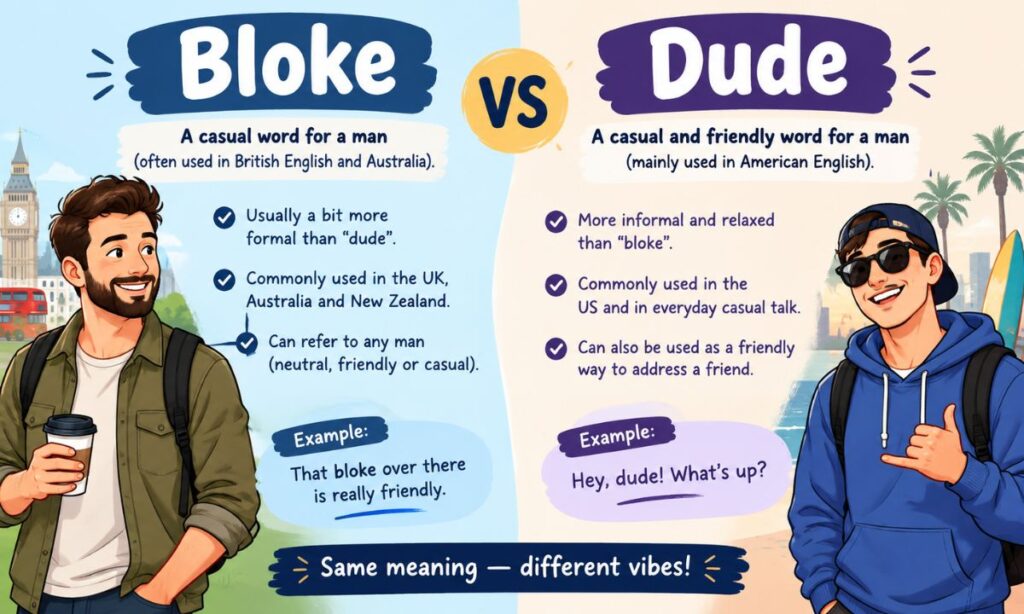
Both words are informal ways to refer to a man, but they come from different cultural backgrounds and carry different connotations.
| Feature | Bloke | Dude |
| Origin | British/London slang | American slang |
| Common regions | UK, Australia, NZ, Ireland, South Africa | USA, increasingly global |
| Tone | Down-to-earth, understated | Laid-back, casual, sometimes surfer/skater culture |
| Can address someone directly? | Rarely (“Oi, bloke” isn’t natural) | Yes (“Dude, check this out”) |
| Cultural association | Everyman, pub culture, practicality | Chill, relaxed, informal friendliness |
In short: “bloke” describes a man, while “dude” can both describe and directly address someone. They’re cousins in meaning but come from different linguistic families.
Bloke Meaning on Social Media
On platforms like X (Twitter), TikTok, and Instagram, “bloke” is used constantly, especially in British meme culture and humorous captions.
Common social media patterns include:
- “This bloke really thought that was a good idea 😂”
- “POV: you’re the bloke at the party who won’t stop talking about crypto”
- Self-deprecating captions like “just a bloke trying to survive Monday”
It’s often used for comedic effect, especially to describe relatable, slightly chaotic, or awkward situations involving an unnamed man. The word’s informality makes it perfect for short-form, casual internet content.
Where Did Bloke Come From?
The exact origin of “bloke” is uncertain, but linguists have traced its earliest recorded use back to 19th-century London.
The earliest known usage is from the early 19th century, when it was recorded as a London slang term, and though many theories exist regarding its etymology, none are considered conclusive.
Some interesting historical notes:
- It reportedly first appeared in court records from London’s Old Bailey around 1829, during a criminal trial.
- One theory suggests the word may derive from the Hindi word “loke,” meaning “a man” — possibly brought back through British colonial contact with India.
- In early criminal slang, a “bloke” specifically referred to a man who was not a criminal, often of higher social standing.
Over time, the word lost its criminal-slang roots and became a general, friendly term for any man — spreading through trade and colonial routes to Australia, New Zealand, and South Africa.
Is Bloke Still Used in 2026?
Yes, “bloke” is still very much alive in everyday British English in 2026. While American-influenced words like “guy” have become more dominant, especially among younger speakers and on social media, “bloke” remains a strong presence in spoken British and Australian English.
It continues to thrive because it:
- Feels distinctly British/Australian rather than Americanized
- Carries a warm, relatable tone
- Works well in humor, memes, and everyday storytelling
- Still appears constantly in TV, football commentary, and pub conversation
So while newer slang comes and goes, “bloke” has proven to be one of the more durable pieces of British vocabulary.
Related Slang Words
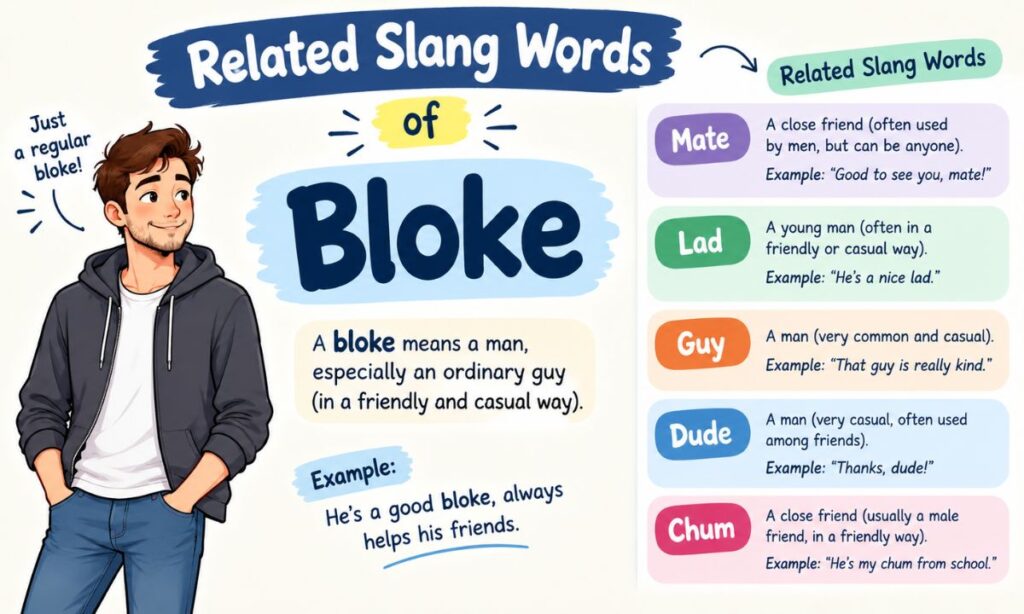
Here are a few other informal British terms for “man” worth knowing:
- Chap – slightly old-fashioned, polite
- Lad – young or energetic man, often used in groups (“lads’ night out”)
- Geezer – working-class, cheeky, London-associated
- Fella – casual and affectionate
- Mate – technically means “friend,” but often used to address any man casually
Conclusion
“Bloke” is a small word that carries a lot of cultural weight. Born in 19th-century London slang, it has traveled across the English-speaking world to become a staple of everyday British and Australian conversation. Whether you’re describing a stranger on the street, a good friend, or even a partner, “bloke” remains one of the warmest, most relatable ways to talk about a man in casual English — and in 2026, it shows no signs of disappearing.
FAQs
What does “bloke” mean?
Bloke means “man” or “guy” — an informal British English term for an ordinary man.
Is “bloke” only used in the UK?
No, it’s also common in Australia, New Zealand, Ireland, and South Africa.
What is the plural of “bloke”?
The plural is simply “blokes.”
How do you pronounce “bloke”?
It’s pronounced “blohk,” rhyming with “smoke” or “joke.”
Is calling someone a “bloke” rude?
No, it’s neutral to friendly — calling someone a “good bloke” is actually a compliment.
What’s the difference between “bloke” and “dude”?
“Bloke” is British/Australian slang for a man, while “dude” is American slang that can also be used to directly address someone.
Where does the word “bloke” come from?
Its exact origin is unclear, but it was first recorded in early 19th-century London slang, possibly from the Hindi word “loke.”
Is “bloke” still used today?
Yes, it remains common in spoken British and Australian English, even alongside newer terms like “guy.”
