
Walk into any playground, classroom, or family gathering today, and you’ll spot them instantly — kids who can navigate a tablet before they can tie their shoes, chat with AI assistants like they’re old friends, and casually correct adults on how technology works. This is Generation Alpha, and they’re reshaping what childhood looks like in the 21st century.
This guide breaks down exactly who Generation Alpha is, what defines them, and why parents, educators, and brands are watching this cohort so closely.
Who Are Generation Alpha?
Generation Alpha, often shortened to Gen Alpha, is the demographic cohort that follows Generation Z. Most researchers and popular media place their birth years between 2010 and 2024, though some sources extend the range to 2025.
Australian social researcher Mark McCrindle coined and popularized the term in a 2008 report. Since the Latin alphabet ran out of letters after Gen Z, this generation became the first to be named using the Greek alphabet instead — hence “Alpha,” the first letter of that alphabet.
A few quick facts to frame who they are:
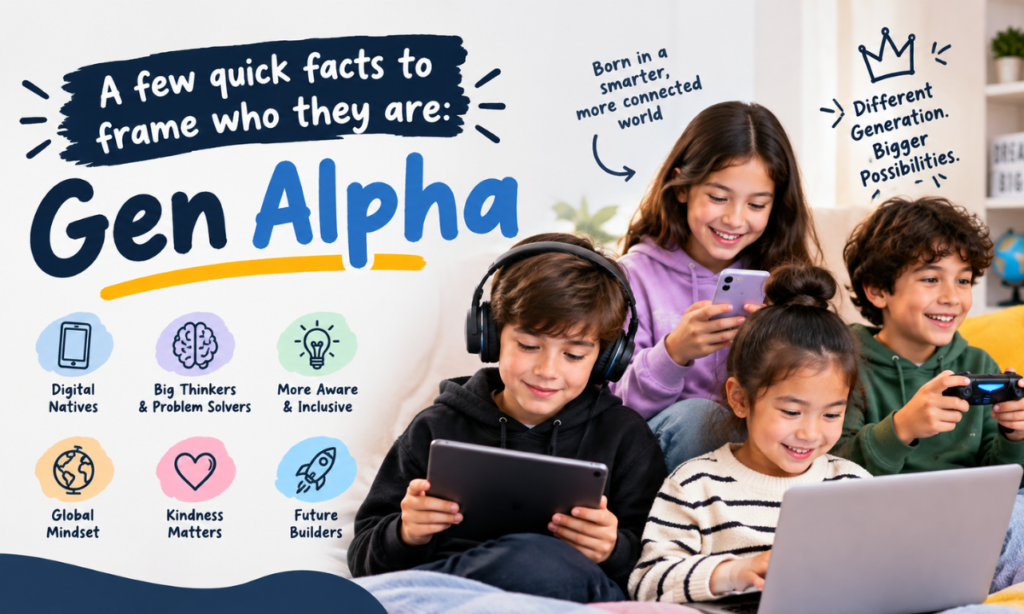
- They are the children of Millennials and, in some cases, younger Generation X parents.
- They are often the younger siblings of Gen Z.
- Globally, more than 2.8 million members of this generation have been born every week.
- By the time the cohort closes out, Generation Alpha is expected to number close to 2 billion people — making it the largest generation in human history.
Generation Alpha Characteristics
Because this generation is still being born and raised, much of what we know about them comes from observing their environment rather than their adult behavior. Still, some consistent traits have already emerged:
- AI-native from day one — Unlike Gen Z, who adapted to artificial intelligence as it emerged, Gen Alpha is growing up with AI assistants, smart speakers, and algorithm-driven content as a default part of life.
- Hyper-connected childhoods — Tablets, smartphones, and streaming apps are often introduced before formal schooling even begins.
- Global awareness at a young age — Constant exposure to international content means many Gen Alpha kids develop an early understanding of world events and cultures.
- Diversity and inclusion as the norm — Growing up in increasingly multicultural households and media environments, Gen Alpha tends to view diversity as ordinary rather than notable.
- Independence and self-direction — With access to endless information, many Gen Alpha children seek out answers and skills on their own, often through video tutorials rather than asking an adult first.
- Environmental consciousness — Raised amid ongoing climate conversations, sustainability messaging reaches this generation earlier than any before it.
The Most Materially Endowed Generation Ever
Despite being the youngest generation, Gen Alpha already wields significant purchasing influence — both directly and through their impact on household spending. Brands have taken notice, tailoring toys, apps, entertainment, and even fast-food marketing specifically toward this age group.
Several factors contribute to this:
- Smaller family sizes in many developed countries mean more household resources are concentrated on fewer children.
- Millennial parents, having grown up with digital marketing themselves, are often more willing to spend on tech-enabled products for their kids.
- Gen Alpha’s early exposure to influencer culture and unboxing content shapes brand preferences from a very young age.
Read our Blog on Meanvix
The Great Screen-Age
Perhaps no trait defines Generation Alpha more than their relationship with screens. This is the first generation for whom tablets and touchscreens existed before they were even born.
| Generation | First Screen Exposure | Primary Childhood Device |
| Millennials | Adolescence/teens | Desktop computer |
| Generation Z | Early childhood | Smartphone |
| Generation Alpha | Infancy | Tablet/Smart device |
This early and constant screen exposure has sparked real debate:
- Supporters argue it accelerates learning, digital literacy, and problem-solving skills.
- Critics point to concerns around attention spans, social skill development, and screen-time-related behavioral issues.
Either way, screens aren’t a novelty for Gen Alpha — they’re simply part of the furniture.
How Will Generation Alpha Learn?
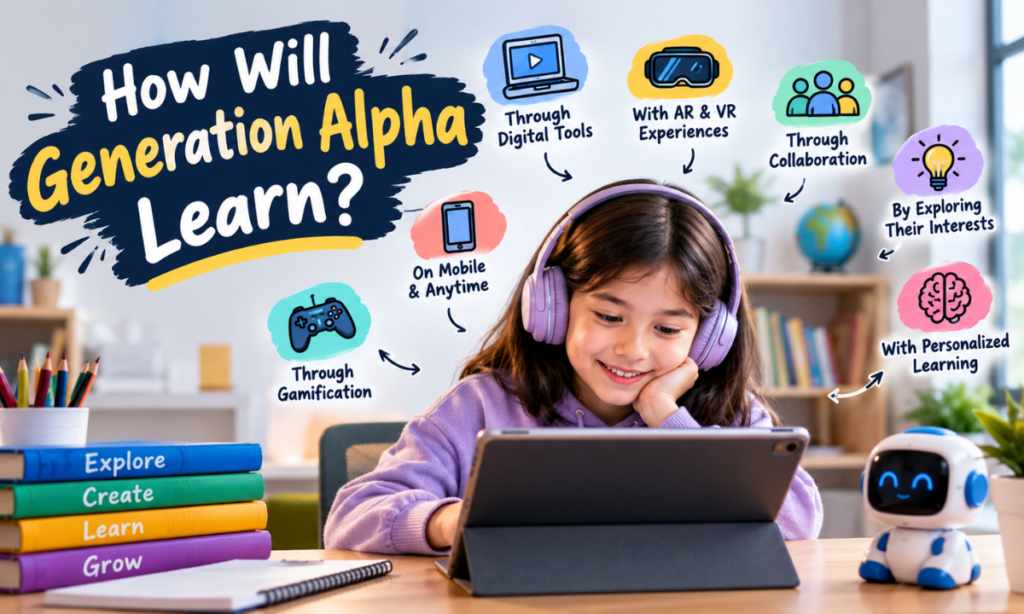
Traditional classroom models are already being challenged by how this generation naturally engages with information. Expect education for Gen Alpha to lean heavily on:
- Personalized, AI-assisted learning platforms that adapt to a child’s pace and style
- Gamified lessons that borrow structure from the video games and apps they already use
- Project-based and real-world learning, emphasizing critical thinking over memorization
- Peer-driven and video-based learning, since many Gen Alpha kids already teach themselves skills through video tutorials
Schools that fail to incorporate some of these elements may struggle to hold this generation’s attention using purely traditional methods.
Empowerment and Resilience of Generation Alpha
Despite genuine concerns around screen time and pandemic disruption, many researchers highlight a more optimistic side to this generation. Gen Alpha is being raised by parents who are generally more emotionally aware and involved than previous generations, often prioritizing mental health conversations at home.
This upbringing is fostering:
- Greater emotional vocabulary and self-awareness from an early age
- Increased comfort discussing feelings and mental health openly
- A stronger sense of agency, as many are encouraged to voice opinions and preferences early on
Human Skills in an AI-Shaped Future
As artificial intelligence becomes deeply woven into everyday life, the skills that matter most for Gen Alpha’s future may shift away from pure technical knowledge toward distinctly human capabilities:
- Creativity and original thinking — skills AI still struggles to replicate authentically
- Emotional intelligence — critical for leadership and collaboration in an automated world
- Critical thinking and discernment — especially important for navigating misinformation and AI-generated content
- Adaptability — the ability to pivot as technology and job markets evolve rapidly
Parents and educators focused solely on technical or coding skills may be missing the bigger picture for this generation’s long-term success.
Generation Alpha’s Economic Footprint
While Gen Alpha isn’t in the workforce yet, their economic influence is already substantial and growing:
- Household spending shifts — parents adjust budgets to accommodate subscriptions, apps, and tech-enabled products for their kids.
- Toy and entertainment industries are increasingly built around interactive, screen-based, and AI-integrated experiences.
- Future workforce implications — as the largest generation in history, their eventual entry into the job market will significantly reshape labor demand, particularly in tech-driven industries.
Education, AI and Declining Fundamentals
One growing concern among educators is that heavy reliance on AI tools and digital shortcuts may be affecting foundational skills. Some patterns being observed include:
- Reduced handwriting practice due to typing and voice-to-text tools
- Declining mental math skills as calculators and apps handle basic computation
- Shorter attention spans linked to fast-paced, algorithm-driven content consumption
This has sparked renewed debate in schools about balancing technology integration with fundamental skill-building.
Advice for Parents
Raising Generation Alpha comes with a unique set of challenges that previous generations of parents didn’t face. A few practical approaches experts recommend:
- Set intentional screen-time boundaries rather than banning devices outright.
- Model healthy tech habits, since children mimic parental device use more than instructions.
- Encourage offline play and social interaction to balance digital engagement.
- Teach digital literacy early, including how to critically evaluate online content.
- Prioritize emotional check-ins, leaning into this generation’s openness around mental health.
The Counter-Trend
Not everyone agrees that Gen Alpha should be treated as a single, uniform group. A notable counter-trend among researchers argues that:
- A toddler and a young teenager within the same generational label live vastly different childhoods, especially regarding pandemic exposure and technology access.
- Many widely circulated “Gen Alpha traits” are predictions rather than confirmed research, since the oldest members are only just entering their teenage years.
- Overgeneralizing an entire cohort risks oversimplifying real developmental and cultural differences within the group.
This perspective encourages treating Gen Alpha characteristics as evolving observations rather than fixed facts.
Why Did We Name Them Generation Alpha?
After reaching the end of the Latin alphabet with Generation Z, researchers turned to the Greek alphabet for the next cohort. “Alpha” — the first letter of the Greek alphabet — was chosen to symbolize a fresh start, marking this group as the first generation born entirely within the 21st century and the third millennium.