

Introduction
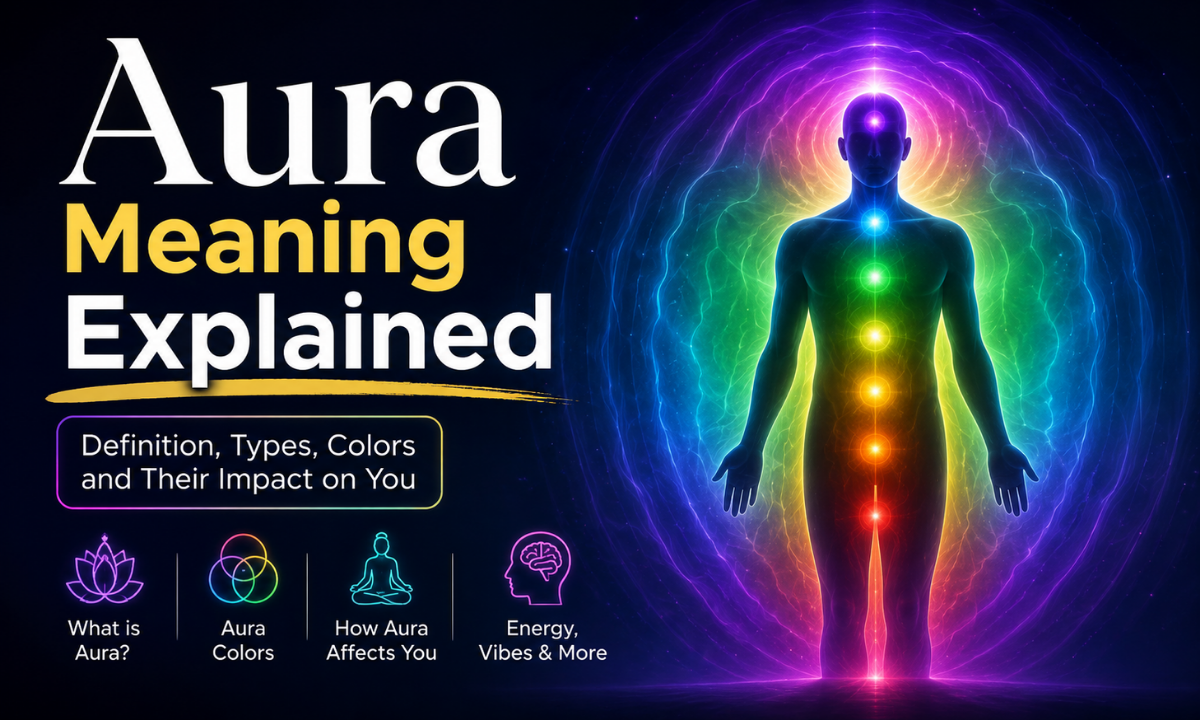
Aura Meaning Explained You’ve probably heard someone say, “She just has an aura about her,” or seen the word trending on social media as “aura points.” But what does aura actually mean, and where does this centuries-old word come from?
In this guide, you’ll learn the full definition of aura, its origin, how it’s used in everyday English, its meaning in spirituality and medicine, and even how to explain it in Urdu. Whether you’re a student, a writer, or just curious after seeing the word everywhere online, this article covers it all in one place.
What Is the Full Meaning of Aura?
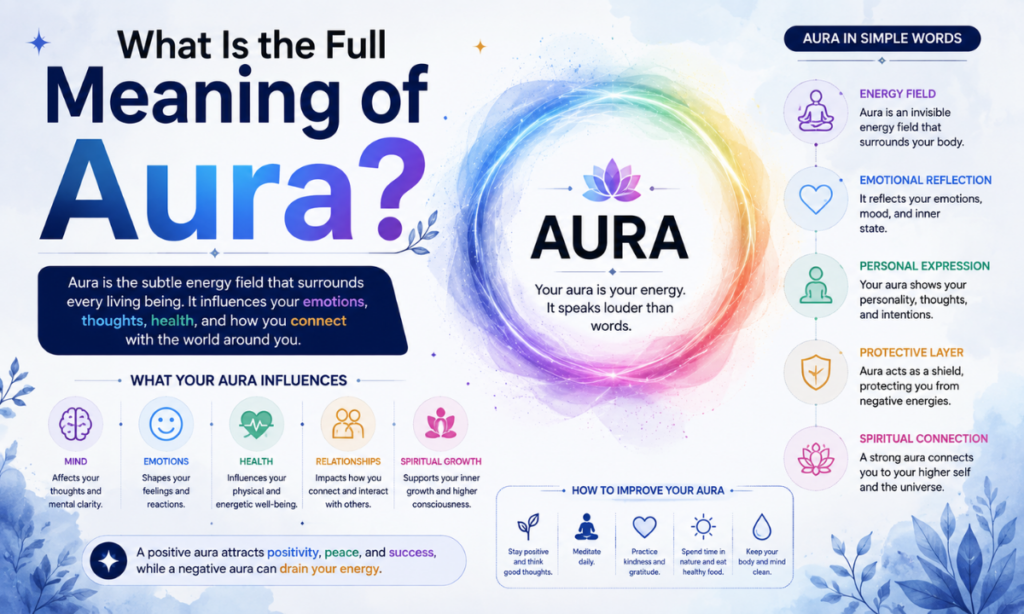
Aura (noun) refers to a distinctive but invisible quality or atmosphere that seems to surround a person, place, or object. It’s something you feel rather than see — an impression rather than a physical trait.
In simple terms, aura means:
- The subtle “vibe” or energy someone gives off
- A characteristic mood or atmosphere surrounding a place or situation
- In medicine, a warning sensation before a migraine or seizure
- In spirituality, an invisible energy field believed to surround living beings
- In modern slang, a person’s overall coolness, charisma, or “vibe rating”
Pronunciation: AW-ruh (/ˈɔːrə/)
Part of speech: Noun
Plural forms: auras or aurae
Where Does the Word “Aura” Come From?
The word aura has a long linguistic history. It traces back to Latin and Ancient Greek, where it originally meant wind, breeze, or breath, and was later used in Middle English to mean “gentle breeze.”
Over time, the meaning shifted dramatically. By the late 19th century, aura had entered spiritualist vocabulary to describe a subtle emanation believed to surround living beings, evolving from an earlier sense of “the characteristic impression made by a personality.” This is when the word began to take on its modern, more mystical connotation.
Read our Blog on Meanvix
Quick Etymology Timeline
| Time Period | Meaning |
| Ancient Greek/Latin | Wind or breeze |
| Middle English | Gentle breeze |
| 1700s | A subtle aroma or emanation |
| 1800s | A personality’s characteristic impression |
| Late 1800s onward | Spiritual energy field around a being |
| 2020s (slang) | Charisma, coolness, or “vibe points” |
Aura Meaning in English (With Examples)
Aura is a versatile word that changes slightly depending on context. Here’s how it’s used in everyday English:
- General atmosphere or feeling Example: “The old library had an aura of quiet mystery.”
- A person’s presence or charisma Example: “The coach walked in with an aura of confidence.”
- Medical sense (pre-seizure or pre-migraine sensation) Example: “She felt an aura of flashing lights just before her migraine started.”
- Spiritual/paranormal sense Example: “Some believers claim they can see the colors of a person’s aura.”
- Modern slang (coolness or reputation) Example: “That trick shot gave him so much aura.”
This last usage has exploded in popularity recently. In slang, aura describes stylishness and confident, suave excellence, often used to praise an athlete or performer’s talent and charisma. On social media, people even say someone gains or loses “aura points” depending on whether they do something impressive or embarrassing.
Different Types of Aura Meaning
1. Spiritual Aura
In spirituality and parapsychology, an aura is described as an energy field surrounding a living being, said to reflect a person’s emotional or physical state. This concept was first popularized in the 19th century by Charles Webster Leadbeater, a member of the mystic Theosophical Society. Believers often describe auras as having different colors, each representing a mood or trait — calm blue, energetic red, or peaceful green, for example.
2. Medical Aura
In neurology, an aura is a warning sign that occurs before a migraine or seizure. It can include:
- Flashing lights or visual disturbances
- Tingling sensations
- Unusual smells or sounds
- A feeling of déjà vu
Sensory auras are actually the second most common type, occurring in 30–40% of people who experience auras.
3. Everyday/Descriptive Aura
This is the most common usage — describing the general “feel” of a person, place, or object. A city can have an aura of history. A room can have an aura of calm. A leader can have an aura of authority.
4. Slang Aura (Modern/Social Media Use)
This newer usage went viral through TikTok trends where users assign “aura points” to social situations — gaining points for smooth, impressive moments and losing them for awkward ones.
Aura: Other Word Forms
| Word Form | Example |
| Noun | aura |
| Adjective | auratic |
| Related noun | mystique |
| Related noun | aureole (halo-like light) |
Synonyms and Related Words
Common words related to or synonymous with aura include:
- Air
- Atmosphere
- Vibe
- Feel / Feeling
- Ambiance
- Mystique
- Halo (in the visual/religious sense)
- Nimbus
Aura vs. Similar Words
| Word | Meaning | Difference from Aura |
| Atmosphere | The general mood of a place | Broader, often used for physical spaces |
| Vibe | Informal feeling from a person or place | More casual/slang |
| Charisma | Personal charm or magnetism | Refers specifically to people, not places |
| Halo | A ring of light around a head | Visual, often religious symbolism |
Vocabulary Lists Featuring “Aura”
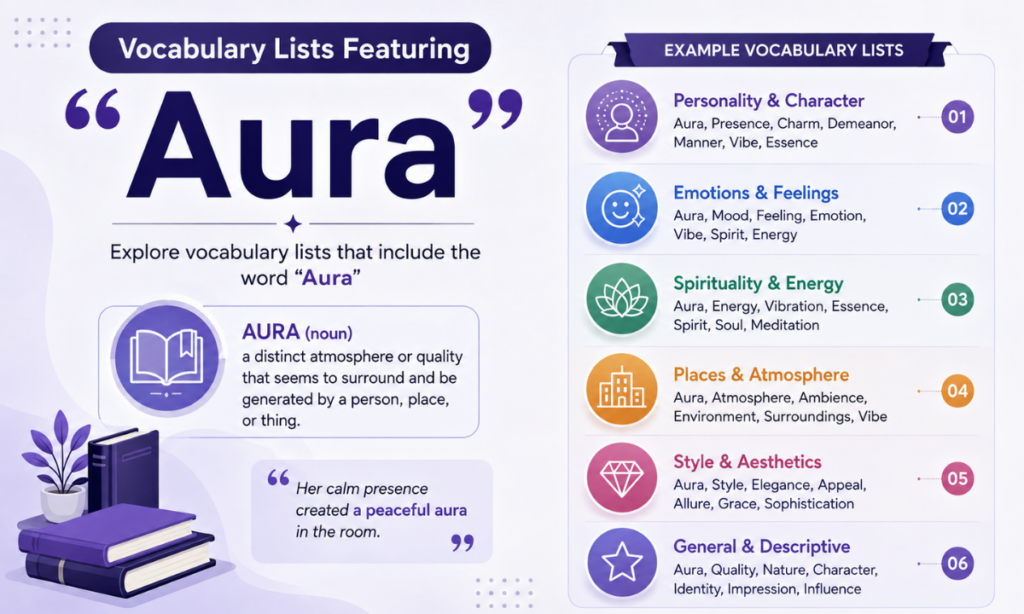
The word aura frequently appears in vocabulary-building resources tied to literature and word games, including:
- Matilda – used to describe character presence and atmosphere
- A Long Way Gone – used in describing emotional and physical settings
- Scrabble word lists – “aura” is a popular choice among four-letter words containing three vowels, since it uses A-U-A and is valuable for quick, high-scoring plays
Example Sentences Using Aura
- The ancient temple had a peaceful aura that calmed every visitor.
- He carries himself with an aura of quiet confidence.
- Before her seizure, she experienced a strange aura of tingling in her fingers.
- The therapist claimed to sense a “heavy” aura around the client.
- His generous personality gives him major aura online.
Frequently Asked Questions About Aura Meaning
What does “aura” mean in simple words?
Aura means the distinctive feeling or impression a person, place, or thing gives off, without being physically visible.
Is aura a real scientific thing?
No scientific evidence supports auras as visible energy fields, though the term is medically valid when describing pre-seizure or pre-migraine sensations.
What does “he has aura” mean in slang?
It means the person appears cool, confident, or impressive in a way others admire.
Can aura be positive or negative?
Yes, an aura can be described as calming, mysterious, intimidating, warm, or unsettling depending on context.
What is the Urdu meaning of aura?
In Urdu, aura (اورا) means a distinctive, invisible impression or feeling surrounding a person or object.
Is “aura” used in medicine?
Yes, it refers to sensory warning signs experienced before a migraine or epileptic seizure.
What’s the plural of aura?
Both “auras” and “aurae” are accepted plural forms.
Conclusion
The word aura has traveled a long way — from meaning a simple breeze in ancient Greek to describing spiritual energy fields, medical warning signs, and now, viral social media slang about coolness. At its core, aura always points to the same idea: an invisible impression that shapes how we perceive someone or something.
Whether you’re using it to describe a mystical energy, a pre-migraine symptom, or your friend’s confident vibe after a great comeback line, understanding aura’s full meaning helps you use the word accurately and confidently in everyday conversation.
