
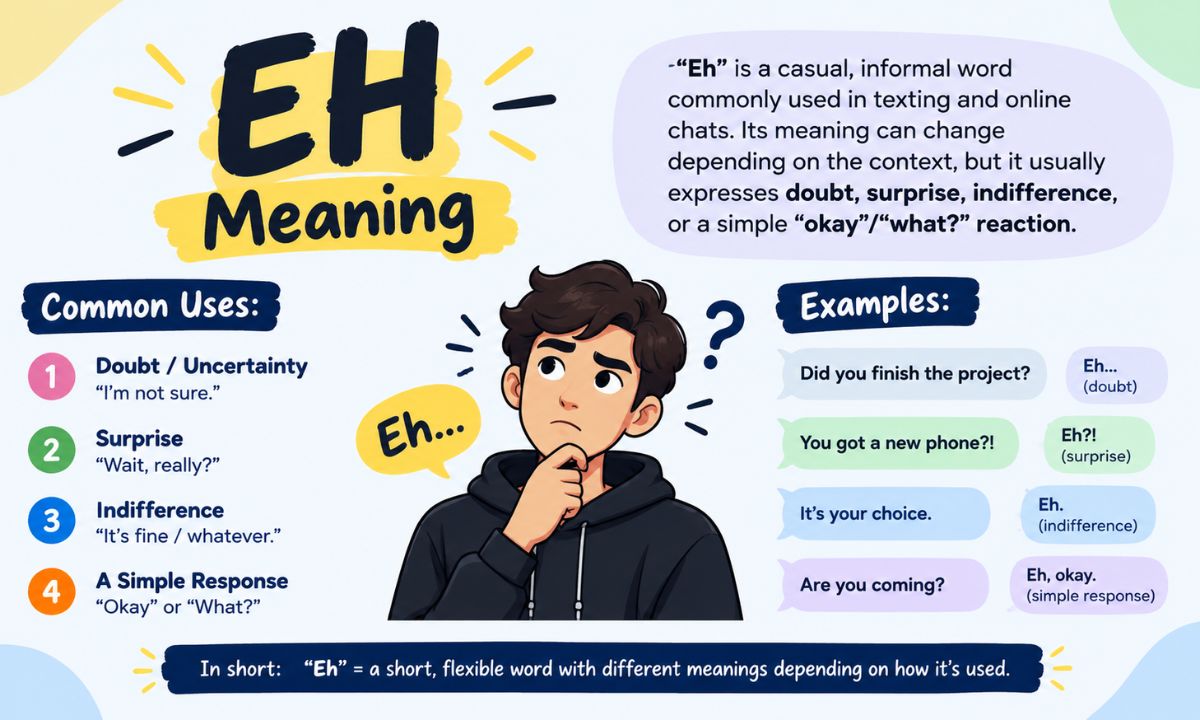

Few words do as much work as “EH Meaning” It can mean “so-so,” “what did you say?”, “I’m not sure,” or “don’t you agree?”, depending on tone and context. This guide covers every common eh meaning, from slang and texting to British, Canadian, and scientific usage. It also covers the difference between eh and meh, and how people use it on TikTok, Instagram, and Snapchat.
Eh Meaning Slang Overview
| Question | Quick Answer |
| What is it? | An interjection (a short word for reaction) |
| Most common slang meaning | “So-so” or “not great, not terrible” |
| Other meanings | “Whatever,” “I’m not sure,” “pardon?”, “right?” |
| Pronunciation | /eɪ/ (like “ay”) |
| Tone | Casual, informal |
| Formal writing? | No |
What Does Eh Mean in Slang?
In slang, “EH Meaning” usually expresses a lukewarm or indifferent reaction. If a friend asks how the movie was and you say “EH Meaning,” you’re saying it was fine but nothing special.
It’s also flexible. Because it’s so short, the meaning comes from three things:
- Tone of voice (flat, rising, or dismissive)
- Punctuation (eh, eh?, eh…)
- Context (what was said just before)
Dictionaries list several senses. They include a question asking someone to repeat themselves, an expression of mild surprise, and a tag asking for agreement.
Eh Meaning as “So-So”
This is the most popular slang use today. It signals average, mediocre, or “could go either way.”
- “How’s the new cafe?” → “EH Meaning, the coffee’s okay.”
- “Did you enjoy the game?” → “EH Meaning. I’ve seen better.”
- “Rate your day.” → “EH Meaning, 5 out of 10.”
A shrug usually goes with it, which is why it’s often compared to a spoken shrug.
Eh Meaning as “I’m Not Sure”
Sometimes eh shows hesitation. The speaker hasn’t made up their mind or doesn’t want to commit.
- “Want to go to the party?” → “EH Meaning, maybe.”
- “Is this a good idea?” → “EH Meaning… I don’t know.”
Here the tone is slower and slightly drawn out. It tells the listener, “Don’t count on a firm answer.”
Eh Meaning in British English
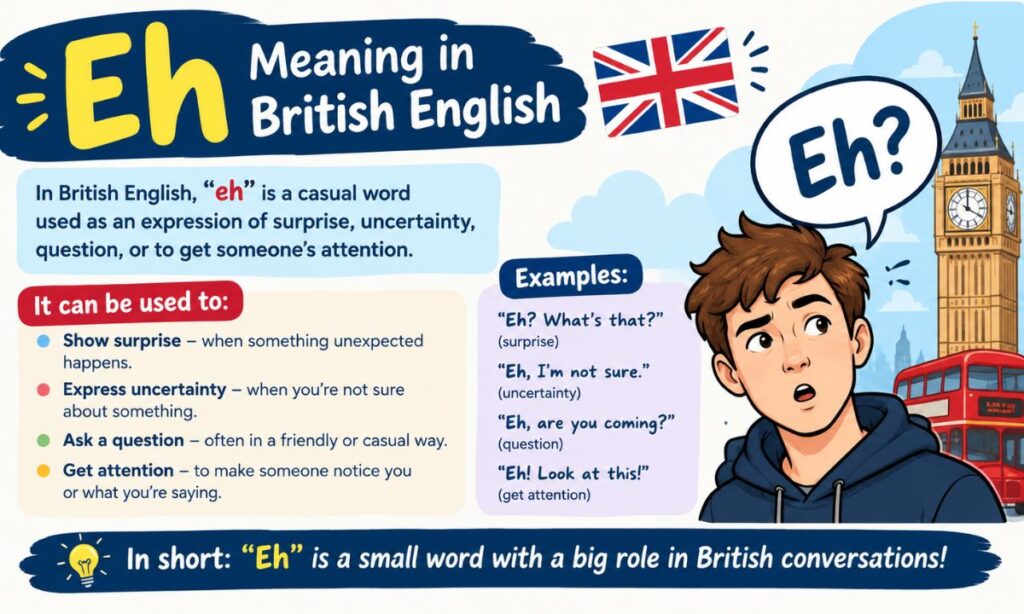
In British English, “EH Meaning?” is a very common way to ask someone to repeat what they said. It’s the equivalent of “What?” or “Pardon?” and is informal.
Examples:
- “Eh? Say that again.”
- “You’re moving to Spain, eh?” (showing surprise)
Regional British English also uses it as a tag, similar to “isn’t it?” For a more polite request to repeat, people add “sorry” or say “pardon.”
Eh Meaning in Science
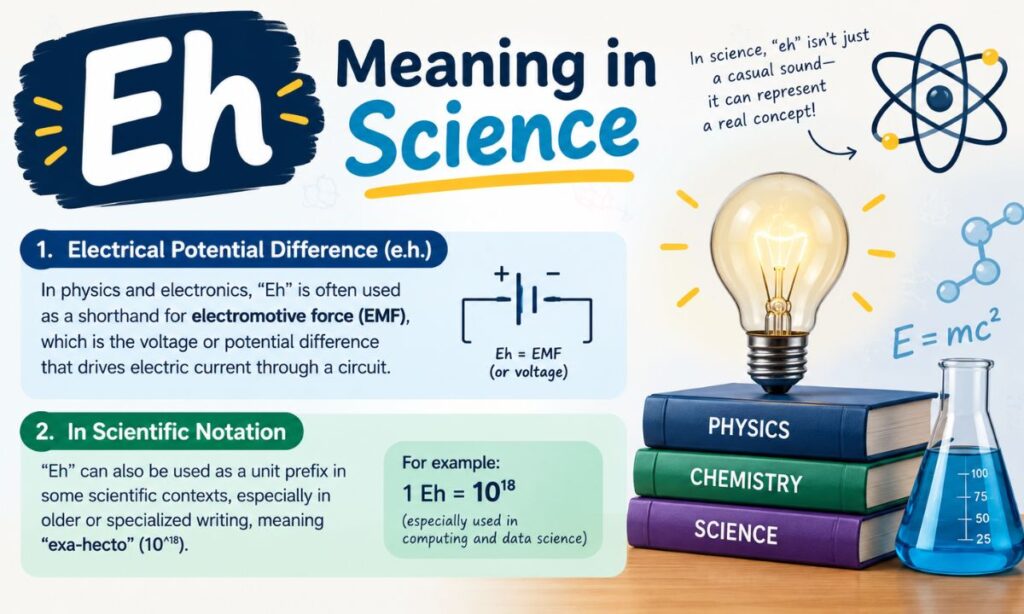
Outside slang, EH Meaning (written with a capital E and lowercase h) is a symbol in chemistry and environmental science. It stands for redox potential, a measure of how easily a solution gains or loses electrons. It’s usually expressed in volts and compared against the standard hydrogen electrode. You’ll find it in soil science, water quality, geochemistry, and Pourbaix diagrams. If you see “EH Meaning” in a science paper, it has nothing to do with a shrug.
Eh Meaning as “Whatever”
Sometimes eh signals mild indifference or dismissal.
- “We could order pizza or Thai.” → “EH Meaning, either works.”
- “Do you care if we skip the museum?” → “EH Meaning, not really.”
Tone matters here. A flat “EH Meaning” can come across as bored or uninterested, so use it carefully in serious conversations.
Eh Meaning as a Question
Eh also works as a question or a tag at the end of a sentence. The common functions are:
- Asking for repetition: “Eh? What did you say?”
- Seeking agreement: “Nice weather, eh?”
- Expressing surprise: “What a game, eh?”
- Making a request: “Put it over here, eh?”
- Storytelling: “So I walked in, eh, and everyone was staring…”
The tag use is strongly tied to Canadian English. Linguists call it an invariant tag because it doesn’t change form. The main uses are stating an opinion, adding an exclamation, making a request, and moving along a story. In Canada it often works as a social glue that invites the listener to agree, rather than as a real question.
Where Did Eh Come From?
The exact origin is hard to pin down, but a few facts are clear:
- Eh has roots in Middle English and didn’t begin in Canada.
- It appears in 19th-century writing. The Clockmaker (1836) by Thomas Chandler Haliburton uses it heavily in dialogue.
- It became strongly linked with Canada in the 1970s and 1980s. Time Magazine ran a 1971 piece titled “Canadian English: It’s a little different, eh?”
- Surveys suggest Canadians use “eh” less than the stereotype implies, and it’s more common in rural areas than in cities.
Even so, “eh” is widely seen as a marker of Canadian identity. It’s also heard in other places, including Australia, where it’s sometimes spelled “ay,” and in similar tag particles in other languages.
Read our Blog on Meanvix
Eh vs Meh
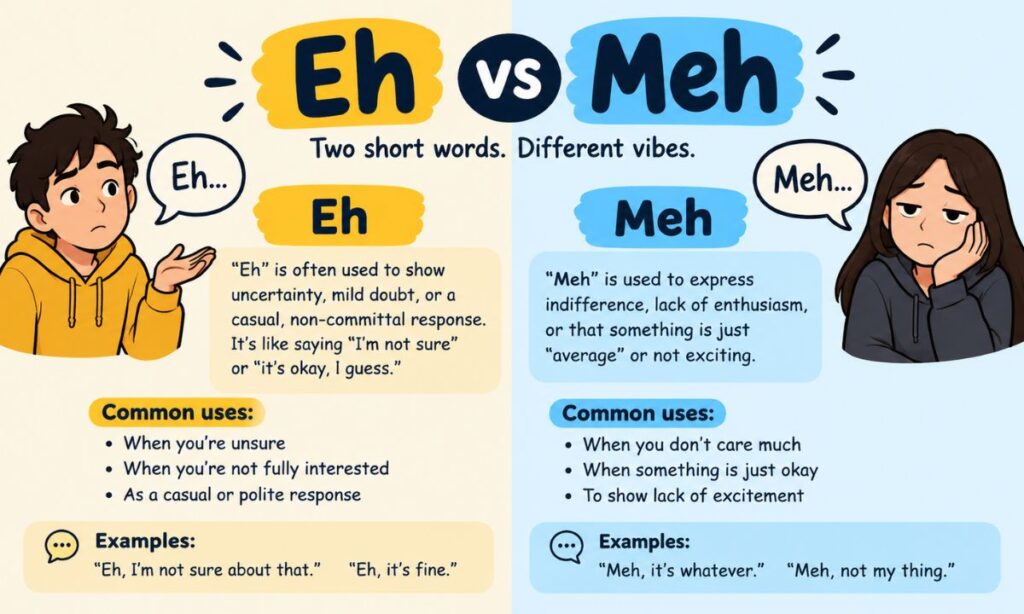
The two look alike, but they aren’t identical.
| Feature | Eh | Meh |
| Type | Interjection | Interjection (also an adjective in casual use) |
| Core meaning | So-so, unsure, “pardon?”, “right?” | Underwhelmed, mediocre, bored |
| Number of uses | Many | Mostly one |
| Tone | Neutral or flexible | Clearly unimpressed |
| Example | “Eh, it was okay.” | “Meh. Not impressed.” |
“Meh” clearly signals mediocrity or underwhelmingness. “Eh” is more flexible and can also work as a question or a tag. If you want to be unambiguous about being unimpressed, “meh” is the safer choice.
Eh Meaning in Text Messages
In texts, eh is mostly used for lukewarm answers or quick reactions.
- “Hungry?” → “eh”
- “How was the concert?” → “eh it was ok”
- “Pizza or sushi?” → “eh whichever”
Be careful with tone. Without a voice or a shrug, a one-word “eh” can look cold or uninterested. Adding an emoji or a few extra words softens it. For example, “eh, kinda 😅” reads friendlier than a bare “eh.”
Eh Meaning on TikTok
On TikTok, eh appears in captions, comments, and voiceovers. Creators use it for deadpan humor, ranking videos, and “so-so” reactions. A creator might rate a food item, a trend, or a product with a flat “eh,” then add a verdict. Comments like “eh, I’d try it” are common. It also shows up in jokes where a Canadian accent is exaggerated.
Eh Meaning on Instagram
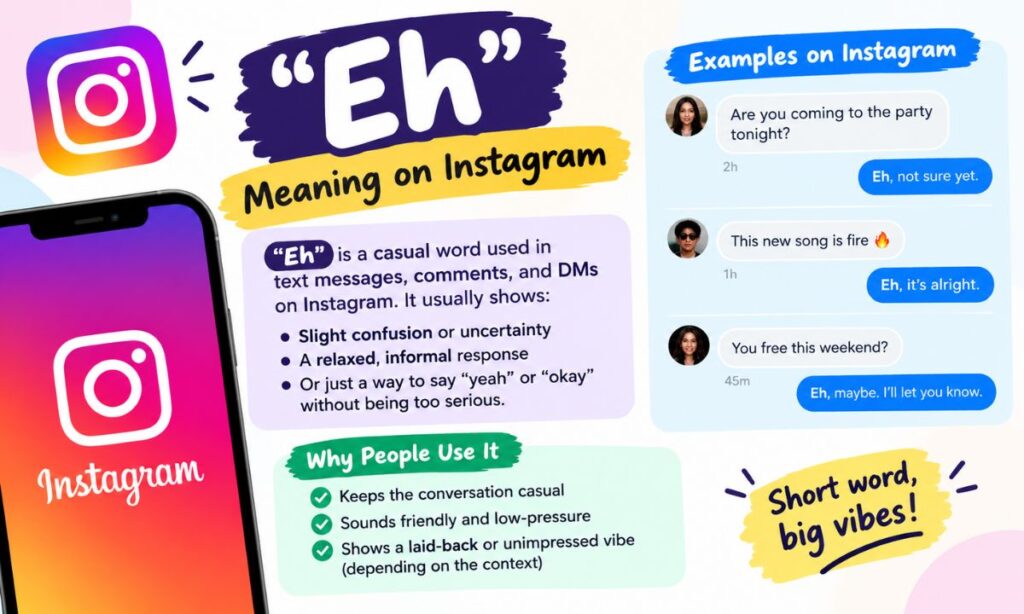
On Instagram, eh shows up in captions, Stories, and comment replies. People use it for casual understatement, such as “Monday mood: eh.” In Stories polls and Q&A replies, it’s a quick way to say “average.” Canadian users sometimes use it as a playful identity marker in posts about weather, hockey, or everyday life.
Eh Meaning on Snapchat
Snapchat messages are quick and informal, so eh fits naturally. A reply like “eh” to “how’s your day?” sends a short, shrug-like response. It often appears as text over a photo of an ordinary or unexciting moment. Because snaps disappear, nobody reads much into a single “eh.”
How to Use Eh Correctly
Follow these simple rules:
- Match your tone. Flat means indifferent, rising means a question.
- Use it casually. It doesn’t belong in formal emails or essays.
- Add context when needed. A short follow-up avoids confusion.
- Avoid overuse. Too many “eh” replies can sound dismissive.
- Know your audience. Use “pardon” instead of “eh?” in polite or formal settings.
Common Mistakes to Avoid
- Assuming it always means “so-so.” It can also mean “what?” or “right?”
- Confusing it with “meh.” Meh is more clearly negative.
- Using it in a serious conversation. It can seem like you don’t care.
- Thinking only Canadians say it. It’s used in several English dialects.
- Mixing it up with the science term. Eh in chemistry is redox potential.
Frequently Asked Questions
What does eh mean in slang?
It most often means “so-so” or “not great, not bad.” It can also mean “whatever” or “I’m not sure.”
What does eh mean in a text?
Usually a lukewarm or indifferent reply, like “it was okay.”
What does eh mean in British English?
Mostly a casual way to say “What?” or “Pardon?”, asking someone to repeat themselves.
What does eh mean in Canadian English?
It’s a tag that invites agreement or confirmation, as in “Nice day, eh?”
What does eh mean in science?
In chemistry and environmental science, Eh stands for redox potential, measured in volts.
Is eh the same as meh?
No. Eh has many uses, while meh specifically signals being unimpressed or bored.
Where did eh come from?
It has Middle English roots and became strongly associated with Canada in the 1970s.
Is eh rude?
Not by itself, but a flat “eh” can sound uninterested, so watch your tone.
Can I use eh in formal writing?
No. It’s informal and works best in conversation, texts, and social media.
Conclusion
“Eh” is a tiny word with a surprisingly wide range. In slang it usually means “so-so,” but it can also signal doubt, indifference, a request to repeat, or a friendly nudge for agreement. Tone and context decide everything. On TikTok, Instagram, Snapchat, and in texts, it works best as a quick, casual reaction. Use “meh” when you want to be clearly unimpressed, and remember that in science, Eh refers to redox potential.
