

Jive Meaning: Understanding Its Slang, Dance, and Cultural Uses
You’ve probably heard someone say “Don’t give me that Jive Meaning,” watched contestants dance the jive on a TV show, or read that a story “doesn’t jive” with the facts. All three uses are real, and they mean different things.
This guide covers what jive means in slang, in text messages, in dance and in music. It also covers where the word came from and how it compares with similar words like vibe and groove.
Jive Meaning Overview
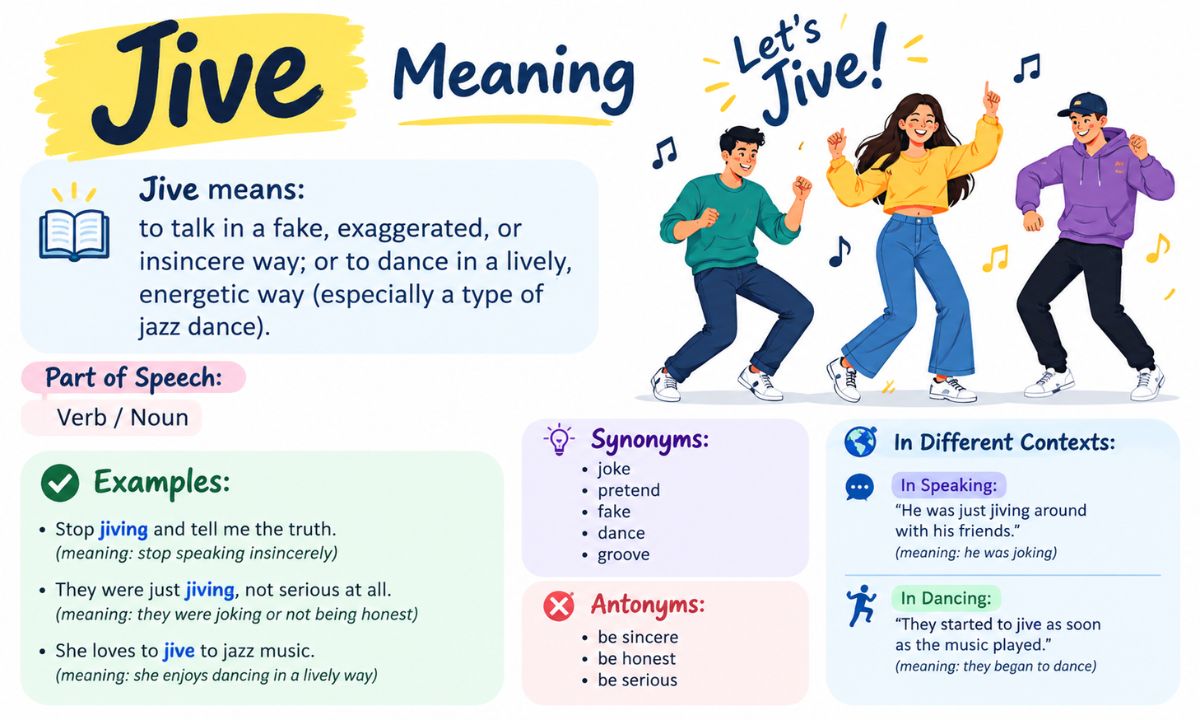
Jive is a word with several meanings, and the context decides which one applies. In short, it can mean:
- Misleading or empty talk (slang)
- A fast, energetic partner dance (dance)
- A style of swing music and the hip language around it (music and culture)
Dictionaries list the first sense as glib, deceptive or foolish talk. They also list it as the jargon of hipsters. Merriam-Webster also defines the verb as talking in a foolish, deceptive or unserious way, or dancing to or playing jive.
What Does Jive Mean in Slang?
In everyday slang, jive usually means nonsense, exaggeration or insincere talk. Calling something jive means you don’t believe it.
Common ways people use it:
- As a noun: “I’m tired of your jive.” (your empty talk)
- As a verb: “Don’t try to jive me.” (don’t try to fool me)
- As an adjective: “That’s a jive excuse.” (a fake excuse)
The adjective has a sharper edge. One etymology source dates the adjective sense of “not acting right” to 1969 in African-American vernacular, and says the stronger form “jive-ass” is generally disparaging.
Jive vs. Jibe: A Common Mix-Up
Many people write “that doesn’t jive with what I heard” when they mean the story doesn’t match. The traditional word is jibe. Merriam-Webster notes that the two have been confused almost since Jive Meaning entered English in the late 1920s, and that using jive to mean “agree” is widely considered an error.
In formal writing, use jibe for “agree.” Use jive for talk, dance or music.
Jive Meaning in Text Messages
Jive is not a standard texting abbreviation like LOL or BRB. Nobody types “Jive Meaning” as shorthand for something else.
When it shows up in a chat, it carries its normal meaning:
- “Stop jiving me” means stop fooling me.
- “That doesn’t jive” means that doesn’t add up.
- “Not my jive” means not my thing. This is informal and a little dated.
Some low-quality “text slang” pages claim “J” or “Jive Meaning” stands for a coded phrase. I found no reliable evidence for that. If someone sends you “jive,” read it by context.
Jive Meaning in Dance
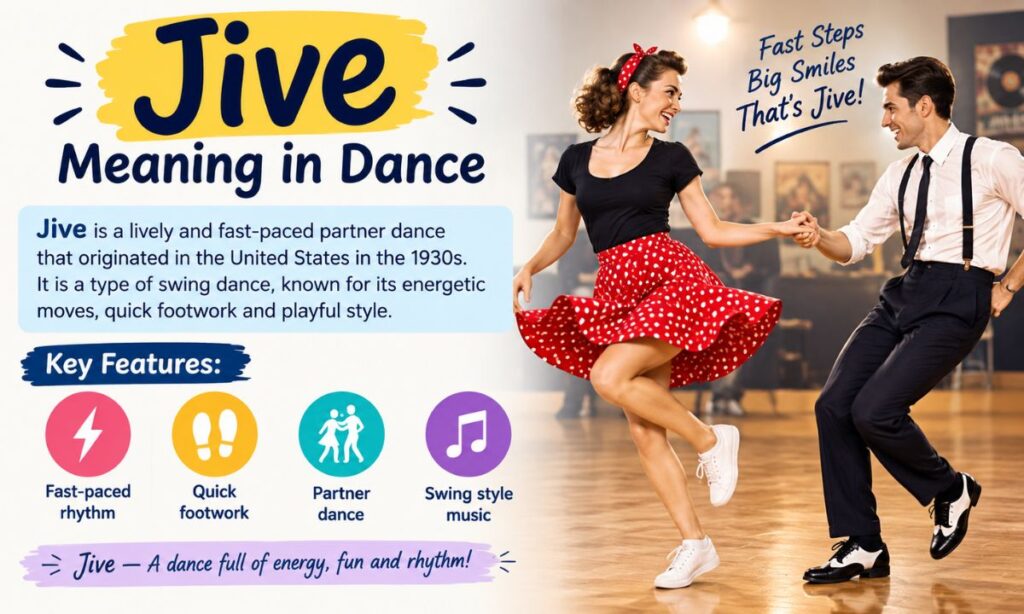
Jive is also a real dance with real steps. It is fast, bouncy and playful, with kicks, flicks and quick rock steps.
The jive began among African Americans in the United States in the early 1930s. In competition ballroom, it is often grouped with the Latin dances, but its roots are in swing dancing rather than Latin dance.
Jive Meaning, Swing and Jitterbug
These terms overlap, which confuses people. In the United States, “swing” became the usual word for the dance, while “jive” became the term in the UK.
| Term | What it usually means |
| Jive | A fast, structured partner dance, now a standard in ballroom competitions |
| Swing | The broad family of partner dances to swing-era music |
| Jitterbug | A casual name for energetic swing dancing |
| Lindy hop | A specific swing dance known for acrobatic moves |
Key Features of the Jive Meaning
- Fast tempo, usually danced to swing, rock and roll or boogie-woogie
- A rhythmic, bouncy feel in the knees and hips
- Quick kicks and flicks
- Energetic spins and partner turns
Today you see the jive mostly on dance shows and in ballroom competitions. It is less common in casual social dancing.
Jive Meaning in Music
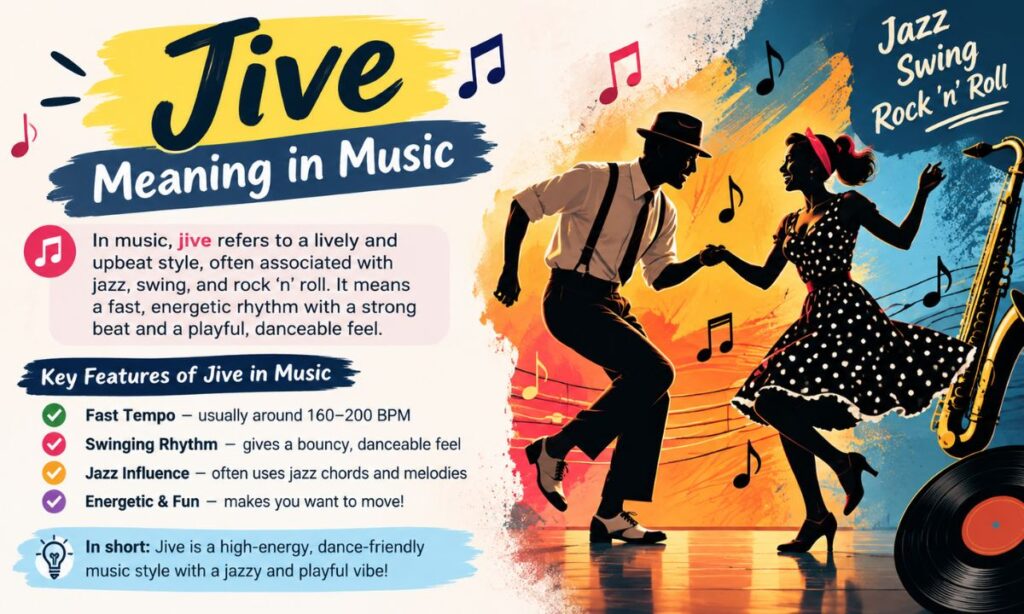
In music, Jive Meaning points to swing and jazz culture. Etymology records show that early on the word also named a style of fast, lively jazz and dance music.
Musicians didn’t only play jive. They talked it. The hip, coded slang of the jazz scene spread through clubs, records and radio. That brings us to the language itself.
Jive Language
Jive talk, also called Harlem jive, was a slang vocabulary of the jazz world. It developed in Harlem and spread more widely through African-American society, peaking in the 1940s.
In 1938, bandleader Cab Calloway published a dictionary of this slang that became the official jive language reference at the New York Public Library.
Jive Meaning talk shaped everyday English. Words and phrases that now feel ordinary, such as “dig,” “hip,” “square” and “cool,” came out of this vernacular and spread through jazz culture.
Where Did Jive Come From?
The exact origin is still debated, but here is what we know:
- Earliest use: Merriam-Webster dates the first known use to 1925. Etymonline places it in 1928 in American English.
- Likely roots: The word is from African-American vernacular and probably of African origin, perhaps from Wolof jev, meaning disparaging talk about someone who is absent.
- First meaning: playful deception and misleading talk. The dance and music senses grew from that.
Because the origin is not settled, treat any single “true” origin story with caution.
Jive Meaning in Pop Culture
Jive shows up across entertainment:
- Dance competitions: the jive is a staple of televised ballroom shows, where couples often perform it in high-energy rounds.
- Movies and TV: characters who “talk Jive Meaning” are often played for comedy, which can lean on stereotypes. That is worth knowing before you imitate it.
- Music: swing revival bands and retro playlists keep the sound alive.
- Phrases: “jive turkey” and “hand jive” are well-known compounds.
Read our Blog on Meanvix.com
Jive vs. Vibe
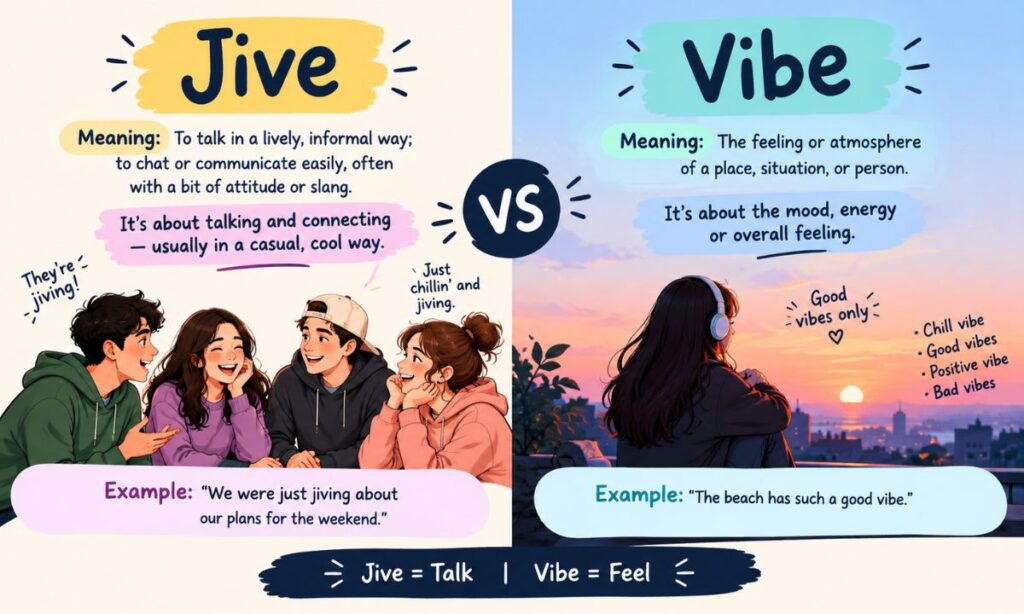
| Feature | Jive | Vibe |
| Core meaning | Deceptive talk, a dance, or swing style | A feeling or atmosphere |
| Tone | Often skeptical or dated | Modern and positive |
| Example | “That’s just jive.” | “This place has a great vibe.” |
| Era | 1920s–1960s roots | Widely used today |
The two sound alike but are unrelated. Vibe is about mood, while jive is about talk or movement.
Jive vs. Groove
| Feature | Jive | Groove |
| Core meaning | Talk, dance or swing style | A steady rhythmic feel |
| Used for | Language, dance, music genre | Music, rhythm, flow |
| Example | “He’s jiving me.” | “The bass line has a deep groove.” |
You can dance the jive while locked into a groove. They describe different things.
Is Jive a Compliment?
It depends on the sense and the setting.
Positive:
- Describing a lively dance: “They nailed the jive.”
- Describing music with swing: “That’s some great jive music.”
- Fond, nostalgic talk about 1940s jazz culture
Negative:
- Accusing someone of lying or bluffing: “Quit the jive.”
- Dismissing an excuse: “That’s a jive reason.”
- Disparaging talk. Be careful here. Mimicking “jive talk” can come across as mocking African American speech.
If you mean to praise someone’s energy, say “great dancing” instead of “jive.”
Jive Meaning in Modern Internet Culture
Jive is not a trending Gen Z term. You’ll see it mostly in these places:
- Dance-show clips and social media videos of jive routines
- Retro and swing-music playlists and nostalgia posts
- Phrases like “doesn’t jive” in news, blogs and comments
- Jive-style “translators” and novelty sites
Younger users usually say “mid,” “cap” or “sus” where older generations said “jive.” The word survives mostly as dance vocabulary and retro flavor.
Related Slang Words
Vibe
A mood or feeling a person or place gives off. It is current and positive. Example: “Good vibes only.”
Groovy
A 1960s word meaning excellent or stylish. It is playful and now reads as retro.
Rad
Short for “radical.” It means awesome and became popular in 1980s youth culture.
Fire
Current slang for something excellent. “That track is fire.”
Fake
This one links back to jive. Etymonline notes that the related word “jivey” has meant jazzy and swinging, but also phony or fake. So “jive” and “fake” share common ground.
Conclusion
Jive is a small word with a big history. As slang, it means nonsense or deception. As a dance, it is a fast and joyful swing-rooted partner dance. As culture, it reaches back to the Harlem jazz scene that gave American English much of its slang.
Use it for deceptive talk, for the dance, or for swing-era music. Use jibe when you mean “agree.” And when you use jive talk, do it with respect for where it came from.
(FAQs)
What does jive mean in slang?
Jive means misleading, exaggerated or empty talk. As a verb, “to jive someone” means to try to fool them.
What does jive mean in a text message?
It has no special texting code. It carries its normal meaning of fooling someone or nonsense, depending on context.
What is the jive dance?
It is a fast, high-energy partner dance with kicks and flicks, rooted in swing. It is now a standard ballroom competition dance.
Is jive the same as swing?
Not exactly. Swing is the broader family of dances, and jive is a faster, more structured style often used in competition.
Where does the word jive come from?
It came from African-American vernacular in the 1920s and is probably of African origin. The exact source is uncertain.
Is it jive or jibe when something agrees?
The traditional word is jibe. Using jive for “agree” is common but widely considered an error.
Is jive an insulting word?
It can be. Calling someone’s talk “jive” accuses them of lying. Imitating “jive talk” can also offend.
What is the difference between jive and vibe?
Jive is deceptive talk or a dance style. Vibe is the mood or feeling of a person or place.
