
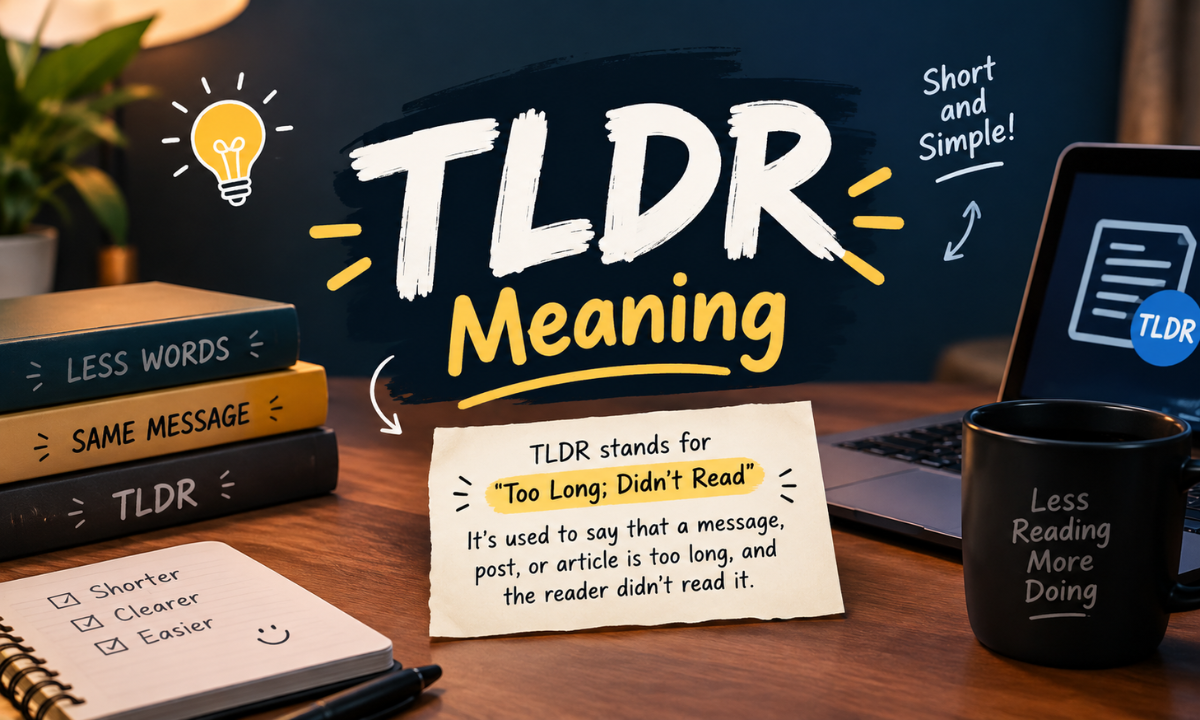

If you spend any time online, chances are you’ve scrolled past the letters “TLDR Meaning” in a Reddit thread, a tweet, or a group chat. It’s one of the most widely used pieces of internet slang, yet plenty of people still aren’t 100% sure what it means or how to use it correctly.
This guide breaks down everything you need to know about TLDR meaning where it came from, how it’s used across different platforms, and how it compares to similar phrases like “summary” or “short version.”
TLDR Meaning Overview
TLDR (also written as TL;DR) stands for “Too Long; Didn’t Read.” It’s an internet abbreviation used to signal that a piece of text is lengthy and that a shorter summary is being offered instead — either by the original writer or by someone responding to it.
The phrase serves two main purposes:
- As a summary marker placed before or after a long post to condense its main point.
- As a comment or complaint used by readers to say a post was too long to read in full.
Read our Blog on Meanvix
Here’s a quick breakdown of how TLDR meaning shifts depending on where you see it:
| Context | Common Meaning |
|---|---|
| Urban Dictionary | Slang term for “too long, didn’t read,” often used humorously or bluntly |
| Research papers | A condensed summary of findings, similar to an abstract |
| Corporate emails | A quick executive summary at the top of a long message |
| Chats/DMs | A shorthand way to ask for or give a quick recap |
TLDR Meaning Urban Dictionary
On Urban Dictionary, TLDR is defined the same way — “Too Long; Didn’t Read” — but the examples lean more casual and blunt. It’s often used as a one-word reaction to a wall of text, sometimes as a joke, sometimes as genuine feedback that a post needs trimming.
TLDR Meaning in Research
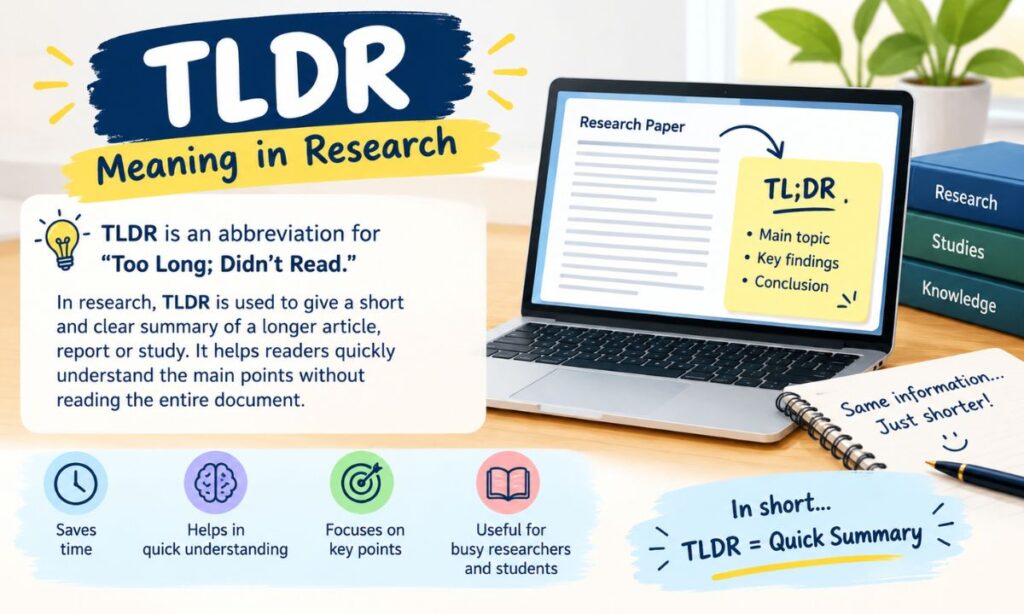
In academic and research contexts, TLDR Meaning takes on a more professional tone. Platforms like Semantic Scholar even generate automatic “TLDR Meaning” summaries for research papers, condensing dense findings into a single sentence so readers can quickly decide if the full paper is relevant to them.
TLDR Meaning in Corporate
In workplace communication, TLDR Meaning is used to make long emails, reports, or Slack messages more digestible. A manager might write a detailed project update and add a “TLDR Meaning” line at the top summarizing the key takeaway in one or two sentences — similar to an executive summary.
TLDR Meaning in Chat
In everyday chat apps like WhatsApp, iMessage, or Discord, TLDR Meaning is casual and quick. It’s often used between friends to skip the details: “TLDR Meaning, the trip got cancelled.”
What Does TLDR Mean in Text?
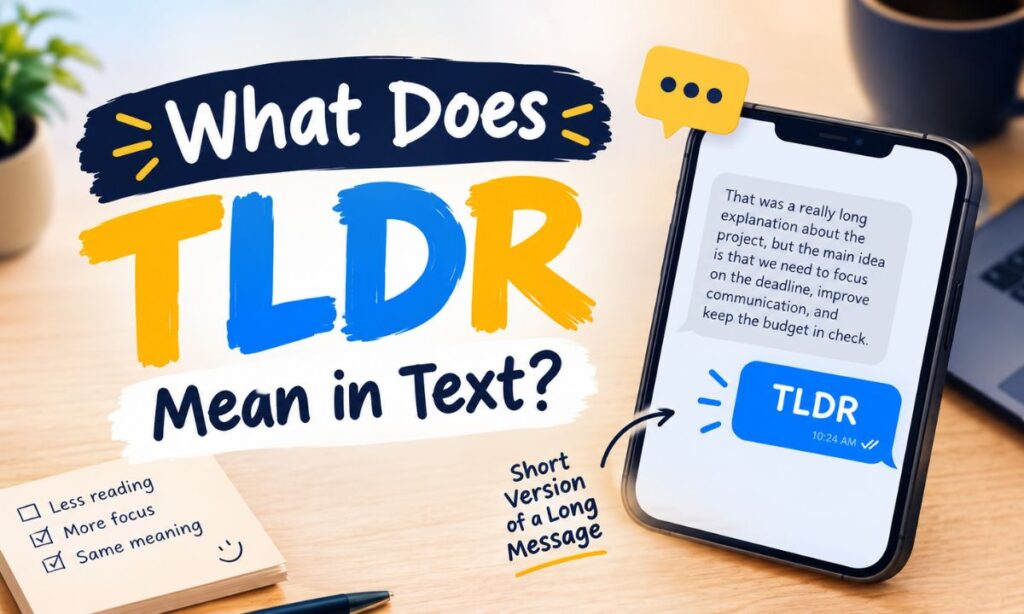
When someone texts you “TLDR Meaning,” they’re usually doing one of two things:
- Summarizing their own long message so you don’t have to read every detail.
- Asking you to summarize something you sent them, as in “what’s the TLDR Meaning?”
Either way, the intent is the same: save time and get to the point faster.
What Does TLDR Stand For?
TLDR Meaning stands for “Too Long; Didn’t Read.” Some variations also use it to mean “Too Long, Didn’t Read” (without the semicolon) or, jokingly, “Too Lazy, Didn’t Read.” All versions carry the same underlying idea — the content was long, so here’s the short version.
Where Did TLDR Come From?
TLDR Meaning has roots in early internet forums and message boards from the early 2000s. According to language references, its earliest documented use dates back to around 2002, when it appeared as a dismissive reply to lengthy forum posts.
Originally, it was used somewhat rudely — a way of saying “your post was too long, so I skipped it.” Over time, as online communication matured, TLDR evolved into something more constructive. Instead of just criticizing long content, people started using it to offer a summary, turning it into a helpful writing convention rather than a snarky comment.
Today, TLDR has become so mainstream that it appears in professional emails, news articles, and even major dictionaries.
How Is TLDR Used Online?
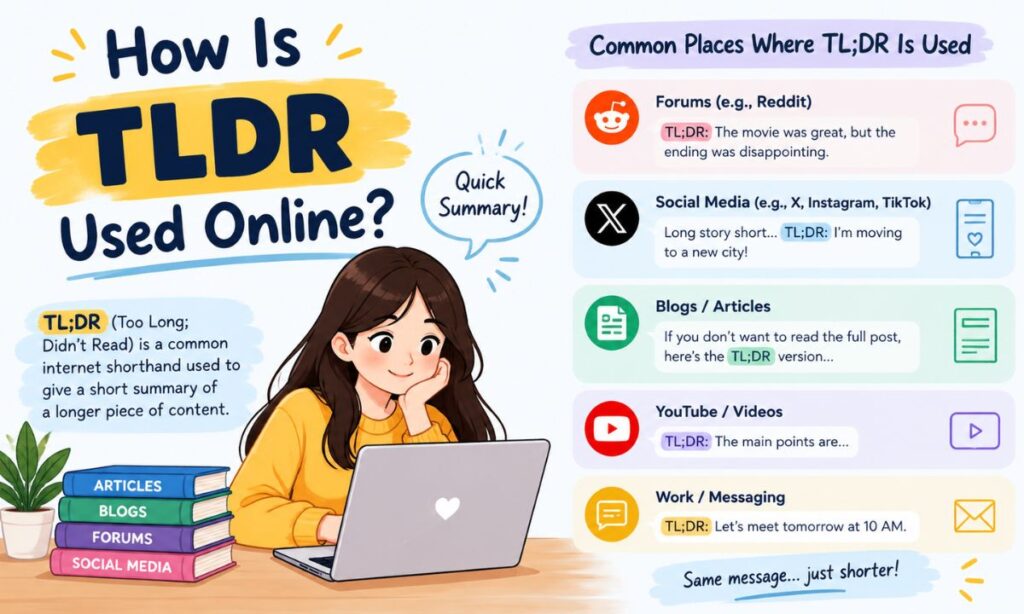
TLDR shows up differently depending on the platform. Here’s how it typically functions across popular sites and apps:
- Reddit – Long personal stories or advice posts almost always end with a “TL;DR” line summarizing the situation in one or two sentences.
- Forums and blogs Writers add a TLDR Meaning at the top or bottom of long articles to help skimmers get the gist quickly.
- Emails A “TLDR Meaning:” section at the start of a long email lets busy recipients grasp the point without reading everything.
- Group chats Used casually to wrap up a long explanation or backstory.
TLDR Meaning on TikTok
On TikTok, TLDR often appears in captions or comments summarizing a longer story told in the video, especially in storytime or “get ready with me” style content. It helps viewers scanning captions understand the point before watching.
TLDR Meaning on Instagram
On Instagram, TLDR is commonly used in caption-heavy posts, especially personal essays or advice content. Creators add a short TLDR line at the top of a long caption so followers can grasp the message even if they don’t read the whole thing.
TLDR Meaning on X (Twitter)
On X, TLDR is frequently used at the start of a thread to preview what the whole thread will cover. This helps readers decide whether to keep scrolling through the rest of the tweets.
TLDR Meaning in Messages
In direct messages and texting apps, TLDR is more conversational. It’s often used playfully between friends, such as replying “TLDR?” to a long paragraph, essentially asking, “Can you sum that up?”
TLDR vs Summary
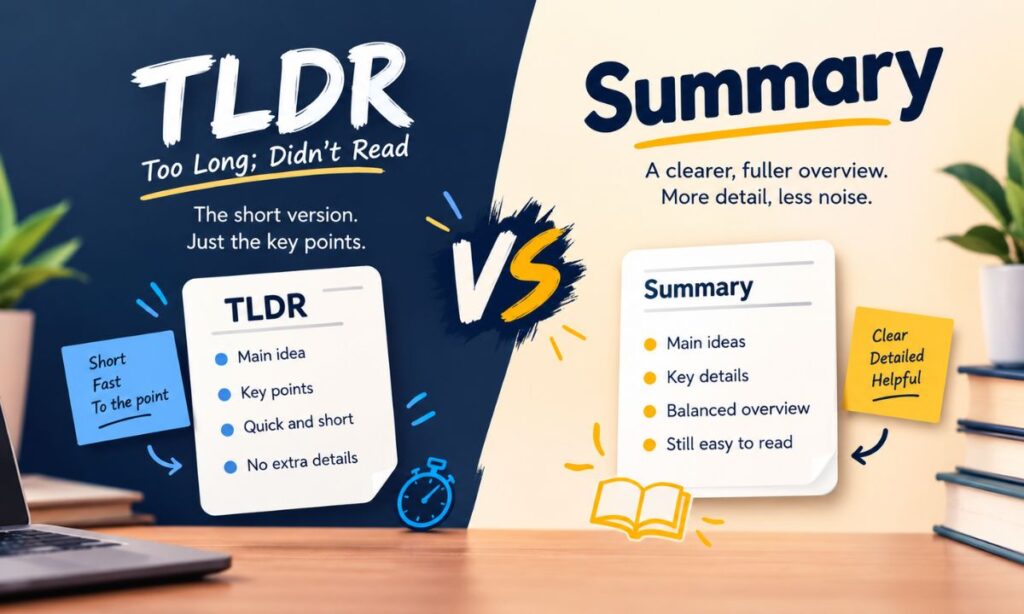
While TLDR and “summary” are closely related, they aren’t identical in tone or usage.
| Feature | TLDR | Summary |
|---|---|---|
| Tone | Casual, internet-native | Neutral, formal |
| Length | Usually 1–2 sentences | Can vary in length |
| Common setting | Social media, chats, forums | Reports, articles, academic writing |
| Placement | Often at the very top or bottom | Can appear anywhere |
In short, a TLDR is essentially a summary, but with a more informal, internet-culture flavor. “Summary” is the more universal, professional term, while TLDR feels more at home in casual digital spaces.
TLDR vs Short Version
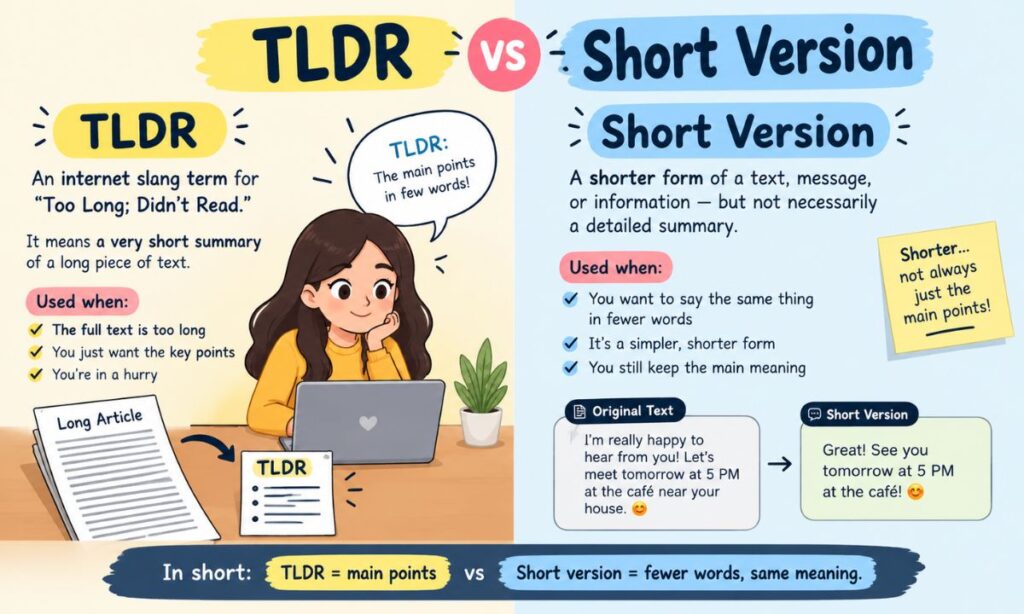
“Short version” and TLDR are often used interchangeably in spoken and written English, but there’s a subtle difference:
- TLDR is specifically tied to internet and digital communication — it implies the original content was long enough that some readers chose not to finish it.
- Short version is a broader, more general phrase that can be used in any context, including spoken conversation, without any internet connotation.
Both essentially mean the same thing: a condensed version of a longer explanation.
Common TLDR Examples
Here are a few real-world style examples showing how TLDR is used in different situations:
- Reddit post: “TL;DR: Moved into a new apartment, landlord ignored maintenance requests for months, finally broke the lease.”
- Work email: “TLDR: Project is delayed by two weeks due to vendor issues; new deadline is the 30th.”
- Text message: “That was a lot lol, TLDR?”
- Twitter thread intro: “TLDR: Here’s why remote work productivity actually went up this year. Thread 🧵”
- Research summary: “TLDR: The study found a 20% improvement in recovery time using the new treatment method.”
Conclusion
TLDR has grown from a blunt internet complaint into one of the most useful shorthand tools in digital communication. Whether it’s summarizing a long Reddit story, condensing a corporate email, or wrapping up a research paper, TLDR meaning always comes back to the same core idea: saving time by getting straight to the point.
Understanding how TLDR is used across platforms — from TikTok captions to professional emails — can help you communicate more clearly and read the room when using it yourself.
FAQs
What does TLDR mean in a text message?
It means “Too Long; Didn’t Read,” used to either summarize a long message or ask someone to sum theirs up.
Is TLDR rude to use?
It can come across as blunt or dismissive in formal settings, so it’s best used casually or when offering a helpful summary.
What is the origin of TLDR?
It originated on early internet forums in the early 2000s as a dismissive response to lengthy posts.
Is TLDR appropriate for professional emails?
Yes, when used to introduce a brief summary at the top of a long email or report.
What’s the difference between TLDR and a summary?
A TLDR is a casual, internet-style version of a summary, typically just one or two sentences long.
