

You’re scrolling through a group chat and someone drops a quick “WWA Meaning in Text?” You know it’s a question, but is it about location, plans, or something else entirely? Three-letter abbreviations like this move fast through texting culture, and WWA is one that trips up a lot of people because it doesn’t have just one fixed meaning.
This guide breaks down exactly what WWA Meaning in Text, how it changes across platforms and senders, and how to reply without sounding confused.
Meaning & Definition
< cite index=”8-1″>WWA Meaning in Text “What We At” or “Where We At.” It’s used to ask about plans or location, and it stays informal — mostly used in casual conversations between friends.</cite> Think of it as a quicker version of “What’s the plan?” or “Where are we meeting?”
WWA Meaning in Text — Urban Dictionary
< cite index=”9-1″>Community slang definitions describe WWA as standing for “Where We At” or, less commonly, “What’s Wrong Again,” depending entirely on the conversation.</cite> The letters stay the same; the surrounding context decides which meaning fits.
WWA Meaning — Where We At
This is the most widely accepted version. < cite index=”12-1″>WWA most often means “Where We At?” in texts and messages — it asks for updates on plans, location, or the current vibe of the moment.</cite> A friend might text “WWA tonight?” to round everyone up without writing a long explanation.
WWA Meaning Slang on TikTok
< cite index=”14-1″>On TikTok, WWA appears in comments and replies, especially in casual back-and-forth conversations,</cite> usually asking what’s happening or where a group discussion currently stands.
WWA Meaning in Text From a Woman
< cite index=”12-1″>From a woman, WWA Meaning in Text “Where We At” when asking about someone’s location or plans</cite> — the meaning doesn’t shift based on gender, just context.
WWA Meaning in Text From a Guy
< cite index=”14-1″>Whether it’s from a guy or a woman, WWA usage stays the same — it depends more on the situation than on who’s sending it.</cite>
Read Our Blog on Meanvix
Usage in Different Contexts
WWA shows up differently depending on the app and the group involved:
| Platform | Typical Meaning | Example |
|---|---|---|
| Group text | Asking about plans | “WWA for dinner?” |
| < cite index=”11-1″>Snapchat</cite> | < cite index=”11-1″>”Where are we going?” or “What are we doing later?”</cite> | “WWA later?” |
| < cite index=”11-1″>WhatsApp</cite> | < cite index=”11-1″>Checking if a place and time are decided</cite> | “WWA for dinner?” |
| Instagram/TikTok | Could be slang, or initials for an event/brand | Depends on caption/hashtags |
| Late-night chats | General check-in | “WWA rn? Bored at home.” |
< cite index=”11-1″>Punctuation changes the tone too — “WWA???” can look impatient, while “WWA when you get a chance?” sounds much softer.</cite>
Meaning in Physics, Medical, and Aircraft Terminology
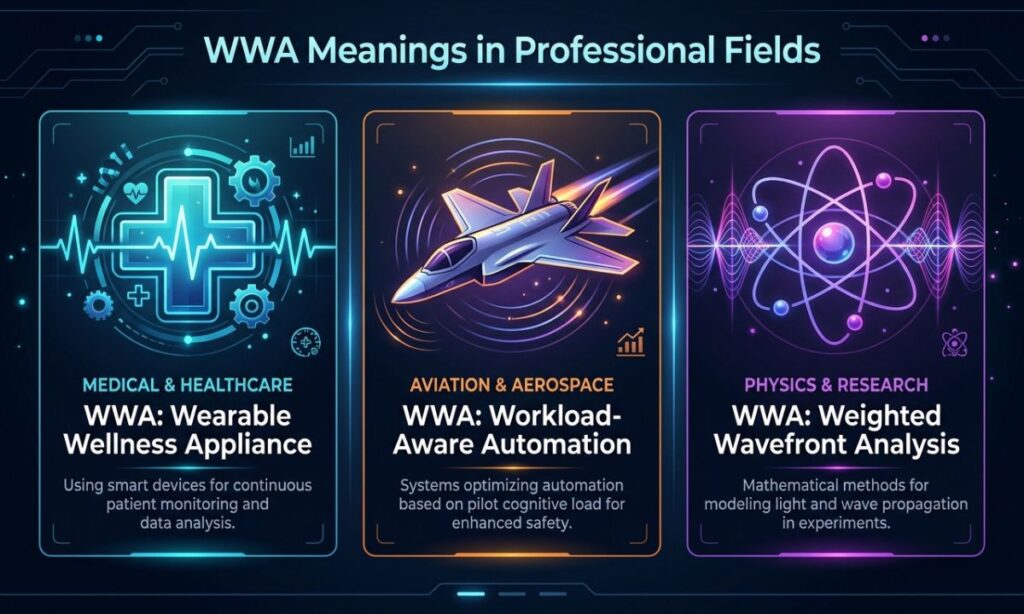
Outside of texting, WWA doesn’t have one locked-in technical definition:
- Physics: < cite index=”17-1″>WWA has no universal physics definition — any use is specific to a particular research paper or laboratory.</cite>
- Medical: < cite index=”18-1″>In some medical settings, WWA can mean “With Wide Awake,” referring to certain procedures done without full anesthesia, though this is internal shorthand rather than a global standard.</cite>
- Aviation: < cite index=”18-1″>In aviation, WWA can refer to warning systems, aircraft assessments, or operational classifications depending on the organization using it, such as aircraft alerts or performance parameters found in manuals.</cite>
If you spot WWA in a technical document rather than a casual chat, it’s almost certainly not the texting slang version.
Common Misconceptions
- Assuming WWA is always negative: < cite index=”21-1″>Many people read “What’s Wrong Again?” into it and assume a frustrated tone, when it’s usually neutral.</cite>
- Confusing it with WYA: < cite index=”9-1″>WYA means “Where You At” and targets one specific person’s location, while WWA asks “Where We At” and addresses the whole group.</cite> Mixing these up can turn a group coordination question into a confusing personal one.
- Treating it as gender-specific: The meaning doesn’t change whether a guy or a girl sends it.
- Assuming one universal definition: < cite index=”13-1″>WWA doesn’t have one official full form across every platform — its meaning shifts with the situation.</cite>
Similar Terms & Alternatives
| Abbreviation | Meaning |
|---|---|
| WYA | Where You At (individual) |
| WYD | What You Doing |
| HMU | Hit Me Up |
| OTW | On The Way |
| WWA | Where We At (group) |
How to Respond to It
Replying to WWA is simple — just answer with the missing detail:
- Share your current location: “At the café.”
- Give a plan update: “We’re meeting at 7.”
- Add specifics if the group needs them: “WWA for the concert? Parking lot?”
- Keep it casual and short — that’s the whole point of the abbreviation.
Differences from Similar Words
< cite index=”21-1″>WYA refers to a single person’s location, while WWA refers to the group collectively — the two aren’t interchangeable,</cite> even though they look nearly identical in spelling. Using the wrong one can accidentally turn a casual group check-in into what sounds like a personal question.
Relevance in Online Conversations & Dating Apps
On dating apps and casual DMs, WWA often works as a low-pressure way to check in without sounding too intense — something like “WWA tonight?” feels lighter than a direct “What are your plans?” It keeps the tone relaxed while still moving the conversation toward making plans, which is part of why it’s stuck around in fast-paced digital flirting and group coordination alike.
Conclusion
WWA is a small abbreviation with a flexible meaning — in almost every casual texting scenario, it boils down to “Where We At” or “What We At,” a quick way to check on plans, location, or group progress. Outside of texting, in fields like medicine, physics, or aviation, it takes on entirely different, more technical meanings that have nothing to do with slang. The key to using or reading WWA correctly is context: who’s sending it, where it appears, and what the conversation is actually about. Once you get comfortable spotting those cues, you’ll never have to second-guess a “WWA?” text again.
