

The TMI meaning is simple: it stands for “Too Much Information.” You see it in group chats, Instagram captions, TikTok comments, and everyday speech whenever someone shares more than anyone asked to hear.
Maybe a friend described a doctor visit in graphic detail, and you replied with three letters: TMI. This guide explains the TMI meaning, its history, how people use it on every major app, and how to respond when someone says it to you.
What Does TMI Mean in Text & Chat?
In text and chat, the TMI meaning is “Too Much Information.” People type it when someone overshares personal, awkward, or unnecessary details.
It works like a friendly stop sign. It says, “I didn’t need to know that,” often with a joke attached.
Full Form, Stands For & Short Meaning of TMI
| Term | Details |
| Abbreviation | TMI |
| Full form | Too Much Information |
| Word type | Acronym / internet slang |
| Tone | Casual, often humorous |
| Used in | Texts, comments, DMs, captions, speech |
| Formality | Informal only |
Short Meaning of TMI
The short TMI meaning is “you’re oversharing.” It can be a joke, a gentle hint, or a real request to stop.
Origin, History & First Known Use of TMI
Oversharing is as old as gossip, but the acronym is newer. Here is the timeline:
- 1988: Wiktionary traces the earliest known use of the abbreviation to 1988, to a former Wall Street Journal writer. That claim is uncited, so treat it with care.
- Late 1990s: By 1998, TMI appeared in the subject lines of online posts as a warning label.
- 2002: Urban Dictionary logged its first definition in October 2002.
- 2003: Forum users said they first heard the phrase on U.S. TV shows and sitcoms.
- 2007: NetLingo listed TMI as text-message shorthand used in forums, chatrooms, emails, and blogs.
Blogging, MySpace, and later Twitter and Instagram made oversharing a daily habit. The TMI meaning became the standard reaction to it.
How People Use TMI in Daily Conversations
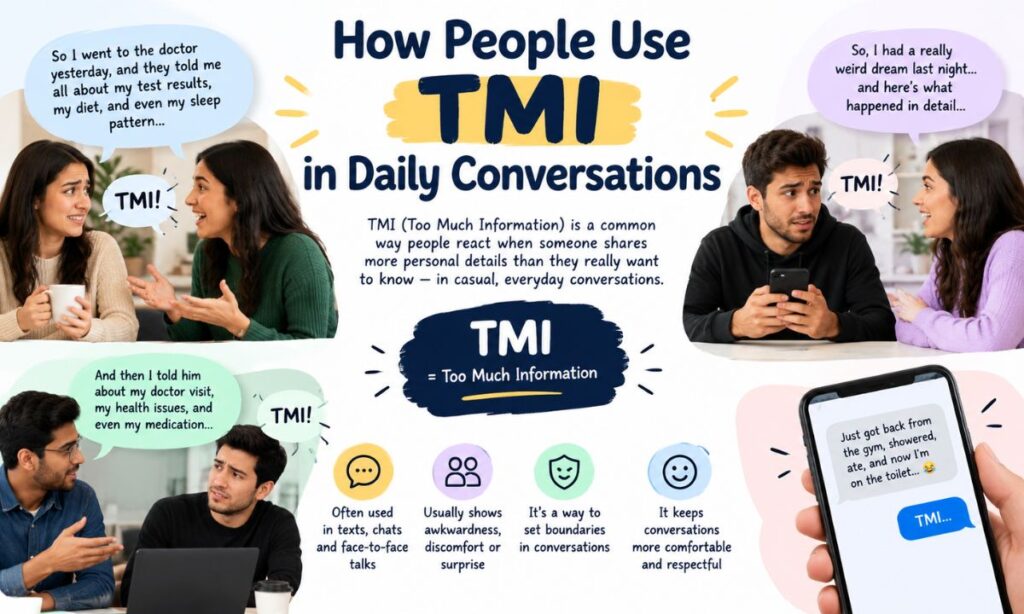
People use TMI in three main ways:
- As a reaction: “TMI!” after an overshare.
- As a warning: “This is TMI, but…” before sharing something personal.
- As a hashtag: “#TMI” on a post that gets personal on purpose.
Texting Examples
- “He told me his whole breakup story on the first date. TMI.”
- “Sorry, TMI, but I’ve had a cold all week.”
- “Bro, TMI. I’m eating.”
Social Media Usage
On public platforms, the TMI meaning is often self-aware:
- A caption like “Stubbed my toe and cried. #TMI.”
- A comment like “Didn’t need this info 😂 TMI.”
- A story that opens with “Okay, TMI time…” before a funny confession.
Casual Situations
People also say it out loud at dinner tables, in office kitchens, and among friends who share a little too much about their weekends.
Read our Blog on Meanvix
TMI Meaning Across WhatsApp, Instagram, TikTok & Snapchat
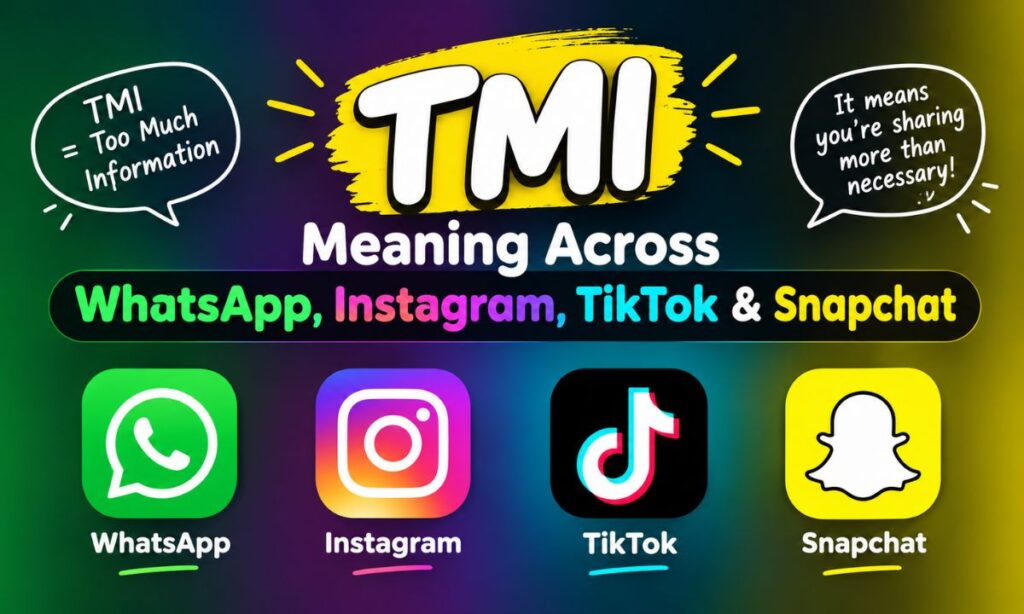
| Platform | Typical Use of TMI | Tone |
| Reacting to long personal texts or voice notes | Friendly, teasing | |
| Captions, story replies, comments | Playful, self-aware | |
| TikTok | Comments on confessional videos | Humorous, dramatic |
| Snapchat | Quick replies to snaps | Short, casual |
Group chats are where TMI thrives. Someone shares a long medical story or family drama, and a friend replies “TMI 😅.” Because these chats are personal, it usually reads as teasing.
People use TMI in captions as a disclaimer, such as “TMI, but I laughed at my own joke for five minutes.” In comments and DMs, it is a light reaction to an overshare.
TikTok
Creators label confessional videos “TMI story time” to warn viewers. Viewers comment it when a story gets very detailed. Here it can be both a joke and a compliment to the storyteller’s honesty.
Snapchat
Snapchat is fast and private, so TMI is usually a one-word reply and rarely a serious complaint.
Does the Meaning Change?
No. The TMI meaning stays “Too Much Information” on every app. Only the tone changes: friends take it as a joke, while a stranger or coworker may mean it as a real boundary.
Different Meanings of TMI in Other Fields
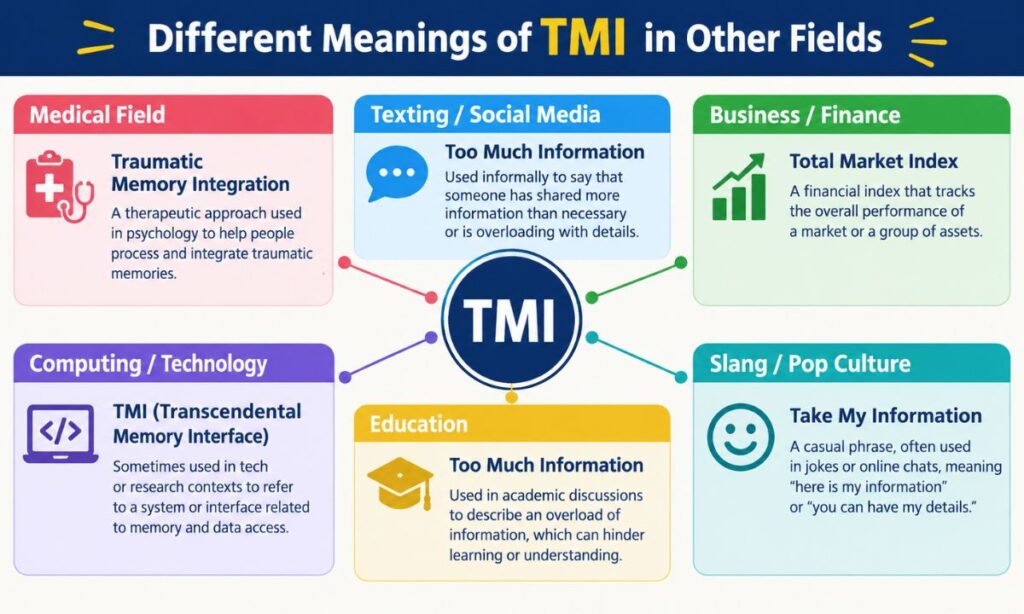
Outside of chat, TMI can mean something else. Context tells you which one applies.
| Field | Meaning of TMI |
| History / Energy | Three Mile Island (the nuclear plant in Pennsylvania) |
| Education | Texas Military Institute (a school) |
| K-pop & entertainment | Fun behind-the-scenes trivia about idols |
| Business | Company names that use the initials TMI |
In K-pop, the TMI meaning is often positive. Fans love small, quirky facts about their favorite stars, so “too much information” is welcome there.
Common Confusions, Mistakes & Wrong Interpretations
People sometimes misread the TMI meaning. Watch for these:
- Thinking it is always rude. Between friends it is usually a joke.
- Confusing it with TMU. TMU is a different texting abbreviation.
- Missing the sarcasm. “TMI, but go on” often means “keep going, I’m curious.”
- Forgetting the overload meaning. Sometimes TMI means you are buried in complicated detail, not just personal detail.
Common Mistakes
- Using TMI in work emails, where it sounds too casual.
- Using it on someone sharing something serious, like grief or illness.
- Overusing it until it loses its humor.
- Mixing up capital and lowercase. “TMI Meaning” is standard, but “tmi” is fine in casual chat.
Similar Terms, Alternatives & Related Slang
| Term | Meaning |
| Oversharing | Revealing too much personal information |
| Spill the tea | Share gossip (the opposite energy) |
| Yikes | A reaction to something uncomfortable |
| Ew / Gross | A reaction to unpleasant details |
| Overshare alert | A playful warning before a confession |
| Not now | A direct way to pause someone |
If you want to skip the acronym, try “That’s more than I needed to know” or “Let’s skip the details.”
Examples of TMI in Real Chat Situations
Chat 1: Friends
A: Just got back from the doctor. They told me everything about my stomach.
B: TMI 😂
Chat 2: Warning first
A: TMI alert, but I haven’t showered in two days.
B: Thanks for the heads-up, I think.
Chat 3: Family group
A: Here’s the full list of my symptoms…
B: Mom, TMI please!
Chat 4: Curious reaction
A: The date went terribly, and here’s why.
B: TMI, but now I need the whole story.
How to Reply When Someone Says TMI Meaning
Your reply depends on whether the person is joking or setting a limit.
Casual Replies
- “Haha, fair enough.”
- “My bad, moving on.”
- “Okay, okay, I’ll stop.”
Funny Replies
- “You asked how I was!”
- “That’s what friends are for.”
- “I’ll add a warning label next time.”
Friendly Replies
- “Sorry, got carried away. Thanks for listening.”
- “Noted! I’ll keep it shorter.”
- “I’ll save the details for later.”
Formal Replies
- “Understood. I’ll keep it brief.”
- “Thank you for letting me know. I’ll be more concise.”
- “Apologies, I’ll stick to the main points.”
If someone says it sincerely, respect it and change the subject. It means they are uncomfortable.
Is TMI Still Popular? Trends & Online Usage
Is Usage Growing or Declining?
The TMI meaning is stable rather than trending. The term has been widely used for over twenty years, and people still understand it instantly. It has not faded the way most slang does.
Who Uses TMI Most?
- Teens and young adults in chats and apps
- Millennials, who grew up with the term
- K-pop and entertainment fans, in the trivia sense
- Anyone who texts casually
Where Is TMI Commonly Seen?
- Text messages and group chats
- Instagram captions and comments
- TikTok videos and replies
- X (Twitter) posts
- Forums and Reddit threads
Quick Facts About TMI
- Stands for: Too Much Information
- Type: Internet slang / acronym
- Earliest reported use: 1988 (uncited)
- First Urban Dictionary entry: 2002
- Tone: Usually humorous, sometimes a real boundary
- Best for: Texts, social media, casual talk
- Avoid in: Formal and professional writing
- Other meanings: Three Mile Island, Texas Military Institute, K-pop trivia
Conclusion
The TMI meaning is “Too Much Information,” and it remains one of the handiest pieces of internet slang for setting a light boundary. It means the same on WhatsApp, Instagram, TikTok, and Snapchat. Only the tone shifts, from playful teasing to a genuine “that’s enough.”
Use it with friends, skip it at work, and keep it light. If someone says it to you, laugh it off and move on.
FAQs
What does TMI stand for?
TMI stands for “Too Much Information.” It is used when someone shares more detail than you wanted.
What is the TMI meaning in texting?
In texting, the TMI meaning is “you’re oversharing.” It is usually a casual or joking reaction.
Is TMI rude?
Not usually. Between friends it is playful, but in serious or formal situations it can feel dismissive.
Can I use TMI at work?
It is best avoided in professional emails and meetings. Try “Let’s focus on the main points” instead.
What does TMI mean from a girl or guy?
It means the same for everyone: they feel you shared more than needed. Emojis usually show it is a joke.
What is the origin of TMI?
The shortened form is reported as early as 1988 and became common online in the late 1990s and early 2000s.
What does “TMI, but…” mean?
It is a warning before sharing something personal, like “TMI, but I cried at that movie.”
What does TMI mean in K-pop?
It refers to fun behind-the-scenes trivia about idols, and fans usually enjoy it.
What does TMI mean on TikTok and Instagram?
It means the same as everywhere: too much information. It often labels a confessional or funny overshare.
Is TMI still used in 2026?
Yes. It is still widely understood and used in texting, social media, and everyday speech.
