


Your friend texts, “I ran five miles this morning, no Cap Meaning” Another replies, “That’s cap.” Confused?
In texting slang, “Cap Meaning” a lie or exaggeration, and “no cap” means “no lie” or “for real.” That is the short answer. But “Cap Meaning” also has other meanings in business, medicine, and education.
This guide covers all of them, plus where the slang came from and how to use it without sounding awkward.
Overview: Cap Meaning vs. No Cap Meaning at a Glance
| Term | Meaning | Example |
| Cap | A lie, an exaggeration, or something hard to believe | “He said he met Beyoncé? That’s cap.” |
| No cap | Telling the truth, “no lie,” “seriously” | “This is the best burger in town, no cap.” |
| Capping | Lying or exaggerating (verb form) | “Stop capping, we all saw the video.” |
| 🧢 | The blue cap emoji, used to call something fake | “Free tickets for everyone 🧢” |
Quick tip: if you can swap “cap” for “lie” and the sentence still makes sense, you have used it correctly.
The Origins of “Cap Meaning” in Slang
The word did not start on TikTok. It has a longer history than most people think.
- Early 1900s: In Black American communities, “capping” was used to mean boasting or exaggerating.
- Hip-hop era: Rappers, especially in Atlanta, helped carry “cap” and “no cap” into mainstream music during the 2010s.
- Late 2010s: The phrase “no cap” spread widely after songs and lyrics popularized it.
- 2020s: Social media made it universal. Now teens, adults, and even brands use it.
Most language experts trace the slang to African American Vernacular English (AAVE). Its exact starting point is debated, so treat any single “official” date with caution.
Why “Cap Meaning” for a lie? One popular theory links it to the idea of “topping” or “capping off” a story with an extra tall tale. Another connects it to “cap” meaning a limit. That would make “no cap” also read as “no limit.”
Read our Blog on Meanvix
Cap Meaning Abbreviation: What Does CAP Stand For?
Written in capitals, CAP is a common abbreviation. The meaning depends on the industry.
| Abbreviation | Full Form | Field |
| CAP | Common Agricultural Policy | European Union |
| CAP | Civil Air Patrol | US aviation volunteers |
| CAP | Corrective Action Plan | Business and compliance |
| CAP | Community-Acquired Pneumonia | Medicine |
| CAP | Cumulative Average Point | Universities (e.g., Singapore) |
| CAP | Centralized Admission Process | Education (India) |
Context tells you which one is meant. A hospital chart and a group chat will never use it the same way.
CAP Meaning in Education
In schools and universities, Cap Meaning usually points to academic systems, not slang.
- Cumulative Average Point: A grade-point style score used by some universities, such as the National University of Singapore.
- Centralized Admission Process: A counseling and seat-allotment system used for college admissions in parts of India. Students often hear about “Cap Meaning rounds.”
- Corrective Action Plan: A structured plan schools use to fix performance or compliance issues.
Students who also use slang can mix these up. “My Cap Meaning is 4.5, no cap” is a perfectly valid sentence.
CAP Meaning in Medical Settings

In healthcare, CAP has a few serious meanings:
- Community-Acquired Pneumonia: A lung infection picked up outside a hospital. This is the most common medical use.
- College of American Pathologists: An organization that accredits laboratories.
- “Cap.” on a prescription: Short for capsule.
If you see CAP in a medical document, don’t read it as slang. Ask your doctor or pharmacist if you are unsure.
Cap Meaning in Business
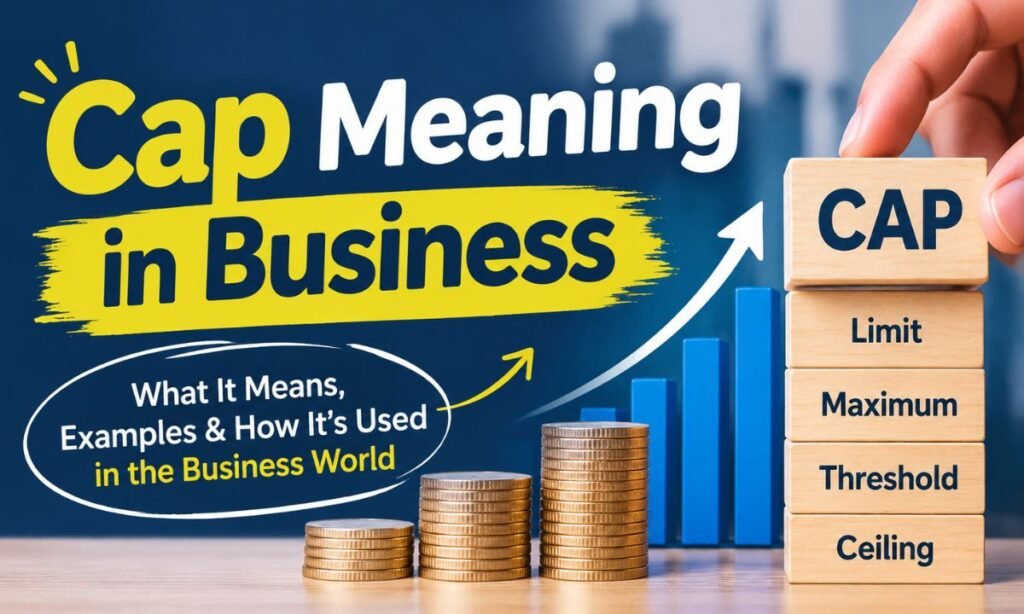
In finance and business, “cap” is short for capitalization or limit. It shows up in many phrases:
- Market cap: A company’s total stock value (share price × number of shares).
- Price cap: A maximum price set by a company or regulator.
- Salary cap: A limit on total player pay in sports leagues.
- Cap table: A record of who owns what share of a startup.
- CapEx: Capital expenditure, meaning money spent on long-term assets.
- Interest rate cap: A ceiling on how high a loan rate can go.
Here is where the slang meets the business term. “No cap” can also mean “no limit,” so a trader could joke, “My spending is no cap.” Both readings work.
Cap Meaning Gen Z: Why Younger Users Love It
Gen Z uses “Cap Meaning” because it is short, punchy, and playful. It lets you call someone out without sounding harsh.
Reasons it caught on:
- It’s fast. Three letters beat “I don’t believe you.”
- It softens conflict. “That’s cap” sounds lighter than “You’re lying.”
- It signals trust. “No cap” adds sincerity to a compliment or a promise.
- It feels like an in-group word. Slang builds identity.
Related Gen Z phrases you may see with it: fr (for real), on god, bet, sus, and deadass.
Cap Meaning in Social Media
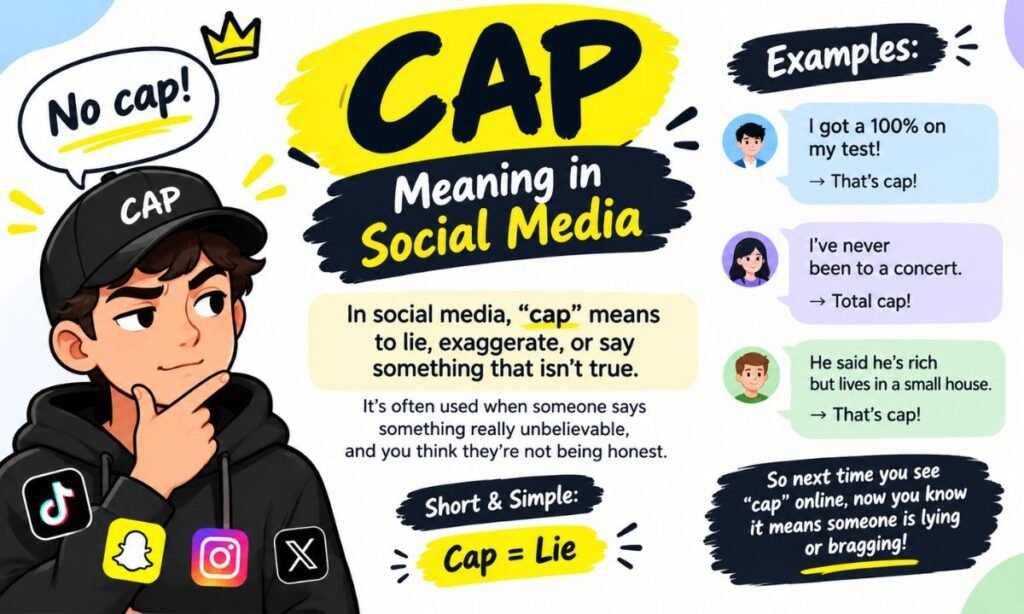
Each platform has its own flavor of “Cap Meaning”
- TikTok: Commenters write “cap” under videos that look staged or exaggerated.
- Instagram: “No cap” often appears in captions about photos, outfits, or achievements.
- X (Twitter): Users reply “cap” to doubtful claims or hot takes.
- YouTube: Comments like “no edits, no cap” are common on challenge videos.
- Snapchat and texting: Short replies like “cap” or “🧢” are quick ways to show disbelief.
How “Cap Meaning” and “Cap Meaning” Are Used Today
You can use both words in several grammatical roles:
- As a noun: “That’s Cap Meaning.”
- As a verb: “You’re capping again.”
- As a modifier: “That’s big cap.”
- As an add-on: “Best concert ever, no cap.”
Common Phrases
- That’s cap: That’s false.
- Big cap: An obvious lie.
- All cap: Everything said is untrue.
- No cap fr: Truly, for real.
- Stop the cap: Stop lying.
Is It Rude?
Between friends, it’s casual banter. In a job interview, a business email, or a talk with your boss, skip it. Use formal wording there.
Examples in Real-Life Scenarios
Here are everyday ways “Cap Meaning” and “no Cap Meaning” appear:
- Group chat
- Friend: “I got 100% on the exam without studying.”
- You: “Cap 🧢”
- Food review
- “This ramen is unreal, no cap.”
- Sports talk
- “He scored from half-court? That’s cap.”
- Online shopping
- “These shoes are worth every penny, no cap.”
- Workplace joke (casual team chat)
- “I finished the report in ten minutes, no cap.” / “Sure, big cap.”
- Business meaning, not slang
- “The company’s market cap passed $1 billion.”
Other Ways to Say “Cap” and “No Cap”
| Instead of… | Try… |
| Cap | That’s a lie, no way, I doubt it, you’re exaggerating |
| No cap | Honestly, seriously, for real, I swear, no joke |
Tips for Using “Cap” Naturally
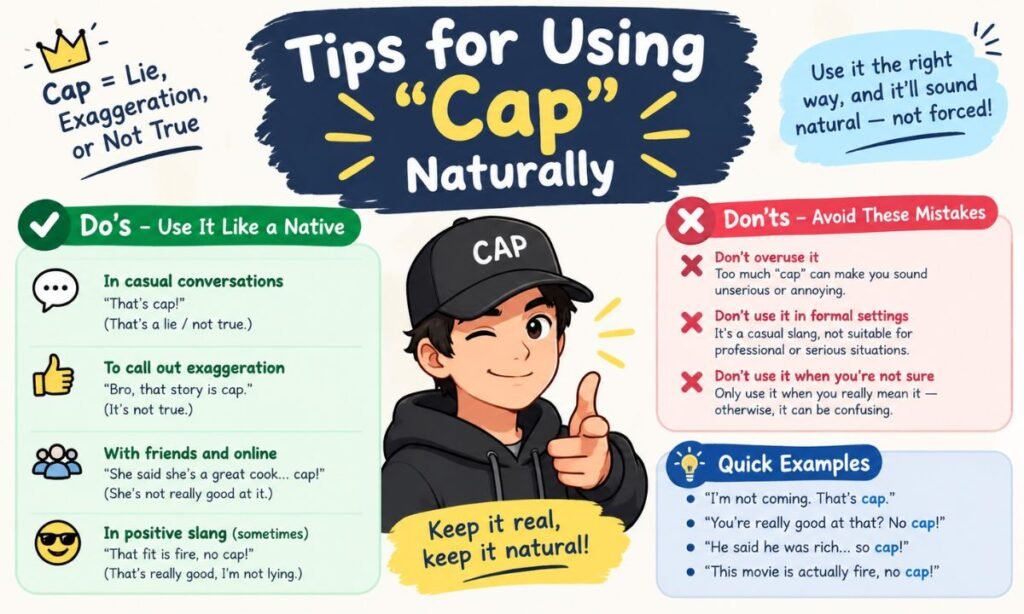
- Match the tone of the conversation.
- Don’t force slang with people who rarely use it.
- Use “no cap” to back up a true statement, not as filler in every sentence.
- Check the context before you decode CAP in a document.
Conclusion
“Cap” means a lie, “no cap” means the truth, and 🧢 is the shortcut for “I don’t buy it.” Outside of texting, CAP can mean market capitalization, pneumonia, an admission process, or a corrective plan.
Read the context, and you will rarely get it wrong. Used in casual chats, these words add personality and clarity. Used in formal settings, stick to plain language.
Frequently Asked Questions (FAQs)
What does “cap” mean in text?
“Cap” means a lie or an exaggeration. Saying “that’s cap” means you don’t believe it.
What does “no cap” mean?
“No cap” means “no lie” or “for real.” It stresses that you are being honest.
Where did “cap” slang come from?
It began in Black American communities in the early 1900s and spread through hip-hop and social media.
What is the blue cap emoji (🧢) used for?
It signals disbelief, like writing “cap” or “I don’t believe you.”
Is “no cap” the opposite of “cap”?
Yes. “Cap” means false, and “no cap” means true.
What does CAP mean in medical terms?
It most often means community-acquired pneumonia. On a prescription, “cap.” means capsule.
What does cap mean in business?
It usually means a limit or capitalization, as in market cap, price cap, or salary cap.
What does “no cap” mean in finance?
It can mean “no limit,” such as having no spending or price ceiling.
Is it okay to say “cap” at work?
Only in casual team chats. Avoid it in formal emails and meetings.
Is “cap” still popular?
Yes. Both terms remain common across social media and everyday speech.
