

Situationship Meaning Overview
If you’ve spent any time on dating apps or social media in the last few years, you’ve probably come across the word “Situationship meaning” It’s one of those terms that seems to be everywhere in TikTok captions, Twitter threads, and late-night conversations with friends trying to figure out “what we actually are.”
A Situationship meaning sits in the gray zone between casual dating and a committed relationship. It’s emotionally real, sometimes physically intimate, but never officially defined. This article breaks down what situationship actually means, where the word came from, how to spot one, and how it compares to other modern dating terms like friends with benefits and the talking stage.
What Does Situationship Mean?
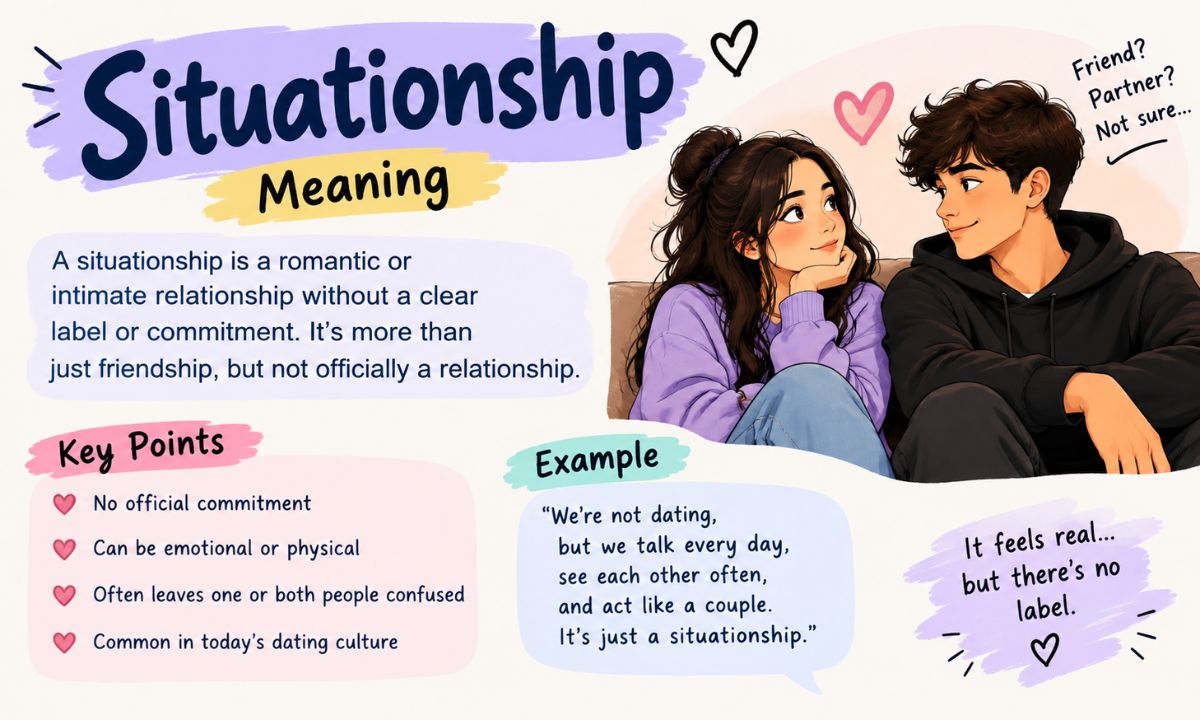
A situationship is a romantic or sexual connection that lacks clear labels, commitment, or an agreed-upon future. It’s more involved than a friendship, but it stops short of an official relationship.
In a situationship, two people may:
- Spend regular time together
- Share emotional and sometimes physical intimacy
- Text or call frequently
- Avoid conversations about exclusivity or “what this is”
The defining feature isn’t the amount of closeness it’s the absence of clarity. Neither person has said out loud what the relationship actually is, so both are often left guessing about where things stand.
Where Did the Term Situationship Come From?
Situationship is a blend word, formed by combining two familiar terms into one.
Situation
The “situation” part points to something undefined and circumstantial — an arrangement that exists because it’s convenient or comfortable right now, not because it was intentionally built.
Relationship
The “relationship” part signals the emotional or romantic closeness involved. There are feelings, routines, and sometimes physical intimacy the hallmarks of a relationship, minus the label.
Put the two together, and you get a word that captures exactly what it describes: a relationship-shaped situation with no defined name. Language references trace the term back to around 2008, though it only became mainstream slang roughly a decade later, spreading rapidly through social media and dating culture in the early 2020s.
Why Are Situationships So Common?
Situationship meaning have become especially common among younger daters, and a few cultural shifts explain why:
- Dating app culture – With endless options a swipe away, many people hesitate to commit to just one person.
- Fear of commitment – Past heartbreak or relationship trauma can make labels feel risky.
- Busy, fast-paced lifestyles – Careers, travel, and packed schedules leave less room for traditional relationship-building.
- Desire for low-pressure connection – Some people genuinely prefer the flexibility of an undefined arrangement.
- Avoidance of hard conversations – It’s often easier to keep things vague than to risk an awkward “what are we” talk.
Signs You’re in a Situationship
Not sure if you’re in one? These are the most common indicators.
You Talk Regularly
Daily texts, frequent calls, or constant social media interaction — the communication looks like a relationship, even though nothing has been defined.
You Go on Dates
You go out, share meals, meet up consistently, and maybe even meet a few friends — all without ever calling it “dating exclusively.”
There’s No Label
Perhaps the clearest sign: if someone asked either of you “so are you two together?”, neither of you would have a confident answer.
| Sign | What It Looks Like |
|---|---|
| Frequent contact | Daily texting or calling, similar to a couple |
| Regular dates | Consistent hangouts, dinners, or outings |
| Physical intimacy | Present, but not necessarily exclusive |
| No defined title | Neither person says “boyfriend,” “girlfriend,” or “partner” |
| Avoided conversations | Talks about the future or exclusivity get sidestepped |
Situationship Meaning on Snapchat
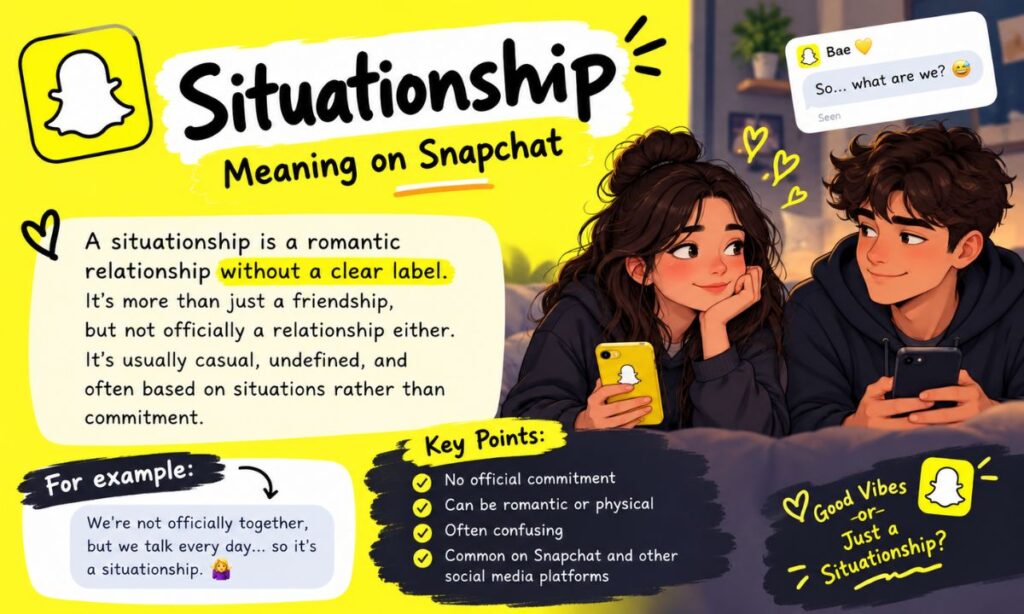
On Snapchat, “Situationship meaning” is often used casually in stories, captions, or Snap streaks to describe someone you’re seeing without commitment think a running streak with someone you’re “not officially” with, or a Snap caption joking about mixed signals. It’s frequently paired with humor or sarcasm, since Snapchat’s format leans toward quick, relatable, meme-style posts about modern dating struggles.
Situationship Meaning on X (Twitter)
On X (formerly Twitter), Situationship meaning shows up constantly in relatable dating discourse — threads about confusing texting habits, jokes about “situationship anniversaries,” or vent posts about someone who won’t define the relationship. The term trends periodically alongside related slang like “talking stage,” “soft launch,” and “the ick,” reflecting how much of today’s dating vocabulary is shaped by social media conversation.
Situationship vs Relationship
The biggest differences come down to commitment, clarity, and expectations.
| Aspect | Situationship | Relationship |
|---|---|---|
| Label | None | Clearly defined (boyfriend/girlfriend, partners) |
| Commitment | Uncertain or absent | Mutually agreed upon |
| Exclusivity | Often unclear | Usually expected |
| Future plans | Rarely discussed | Openly discussed |
| Communication | Inconsistent expectations | Established norms |
| Security | Low, due to ambiguity | Higher, due to clarity |
Situationship vs Friends With Benefits
These two terms get confused often, but they’re not identical.
- Friends With Benefits (FWB): Centers primarily on physical intimacy between friends, with an explicit understanding that romance and commitment are off the table.
- Situationship: Can include physical intimacy, but also carries emotional closeness and romantic undertones — the confusion isn’t about avoiding romance, it’s about never clarifying it.
Read our Blog on Meanvix
In short: FWB usually has clear (if unspoken) rules. A situationship usually has no rules at all.
Situationship vs Talking Stage
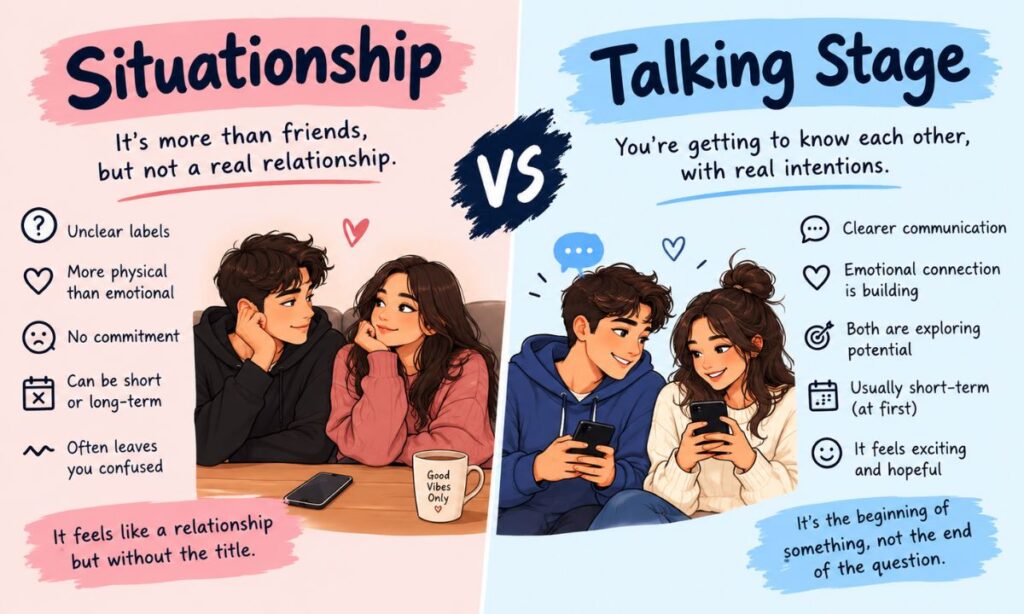
The talking stage is typically the early, getting-to-know-you phase before two people decide whether to date. It’s short-term by nature and often leads somewhere — either into dating or nowhere at all.
The talking stage is typically the early, getting-to-know-you phase before two people decide whether to date. It’s short-term by nature and often leads somewhere either into dating or nowhere at all.
| Aspect | Talking Stage | Situationship |
|---|---|---|
| Duration | Usually short | Can last indefinitely |
| Purpose | Deciding whether to date | Often stuck in limbo |
| Intimacy level | Lower, still building | Can be deep and established |
| Outcome | Leads to a decision | Often left unresolved |
Why Do Situationships End?
Situationships tend to end for a handful of recurring reasons:
- Mismatched expectations – One person wants commitment; the other doesn’t.
- Emotional exhaustion – Constant uncertainty becomes draining over time.
- A new relationship enters the picture – One party moves on to something more defined.
- The “define the relationship” talk goes badly – Attempts to add clarity expose incompatible goals.
- Natural fade-out – Without structure or commitment, situationships often just fizzle rather than end with a clean break.
Popular Situationship Quotes
Social media has produced no shortage of quotable lines capturing the situationship experience. Common sentiments circulating online include ideas like:
- Being “everything but official” with someone
- Feeling like you’re “auditioning” for a relationship that may never happen
- Describing a situationship as “commitment without the commitment”
These quotes resonate because they capture the emotional limbo so many people recognize from their own dating lives.
Common Social Media Sayings
Alongside “situationship,” a cluster of related slang terms frequently appears together across apps:
- Soft launch – Subtly hinting at a new person on social media without confirming the relationship
- Talking stage – The early phase of getting to know someone romantically
- Breadcrumbing – Giving just enough attention to keep someone interested without real commitment
- The ick – A sudden loss of attraction, often triggered by a small moment
- Situationshippers – A playful term for people who tend to end up in these undefined dynamics repeatedly
Is Situationship a Negative Term?
Not inherently. The term itself is neutral — it simply describes an undefined connection. Whether it’s positive or negative depends on the people involved:
- It can feel freeing for those who want low-pressure companionship without obligations.
- It can feel frustrating for those craving clarity, security, or a defined future.
The word carries emotional weight mainly because of the uncertainty it represents, not because “situationship” itself implies something bad.
Is Situationship Still Popular in 2026?
Yes. Situationship remains firmly embedded in everyday dating vocabulary. With dating apps continuing to dominate how people meet, and social media constantly generating new relationship slang, the term shows no signs of disappearing. It’s now a standard part of the modern dating lexicon, regularly used in casual conversation, memes, and relationship discussions alike.
Conclusion
A situationship captures something many people have experienced but struggled to name: a connection that feels like a relationship without ever becoming one officially. Understanding situationship meaning — from its origins to its signs, and how it differs from friends with benefits or the talking stage — can help you recognize where you stand in your own dating life. Whether a situationship works for you or leaves you wanting more clarity, knowing the term gives you the language to talk about it honestly.
FAQs
What is the simplest definition of a situationship?
It’s a romantic or sexual connection that lacks a clear label or commitment, sitting between friendship and an official relationship.
Can a situationship turn into a real relationship?
Yes, it can — but only if both people communicate openly and agree to define the relationship together.
Is a situationship the same as dating?
Not exactly; dating can lead to commitment, while a situationship typically stays undefined for longer periods.
How long do situationships usually last?
There’s no fixed timeline — some last a few weeks, while others continue for months or years without resolution.
Why do people prefer situationships over relationships?
Many enjoy the reduced pressure and flexibility, avoiding the expectations that come with a committed relationship.
Is it healthy to be in a situationship?
It can be, as long as both people are comfortable with the ambiguity; it becomes unhealthy when one person wants more clarity than they’re getting.
