
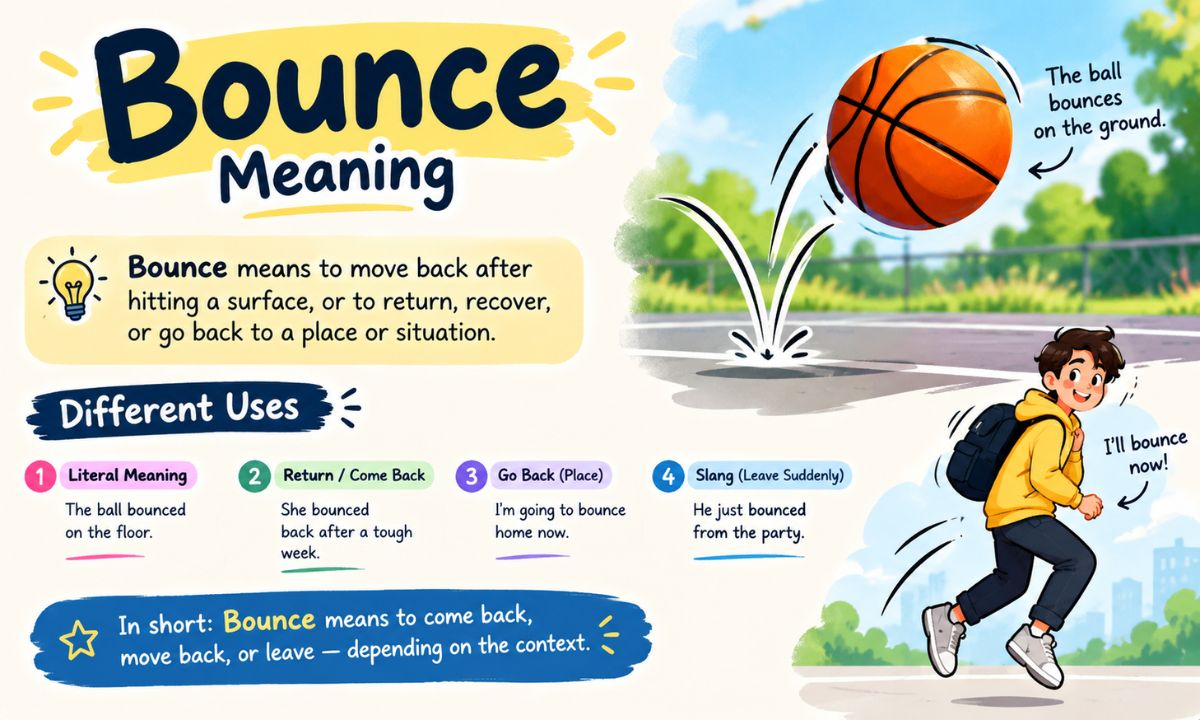

A friend texts, “This party is dead, let’s Bounce Meaning” No ball is involved, and nobody is jumping. They just want to leave.
“Bounce” is one of those everyday words with a double life. It can describe a ball, a bad check, a returned email, or a quick exit. This guide covers the slang meaning, popular phrases like “let’s bounce,” how it differs from similar words, and how to use it naturally.
What Does Bounce Mean in Slang?
Simple Definition
In slang, “Bounce Meaning” means to leave a place quickly and casually. It’s the same idea as “head out,” “split,” or “dip.”
Quick examples:
- “I’m bored, I’m gonna Bounce Meaning.”
- “We bounced before the movie ended.”
What Does “Bounce Meaning” Really Mean?
The slang meaning is about moving on. Someone is done with a place, a plan, or a situation, and they’re going somewhere else or going home. It’s casual and usually unemotional.
Why Do People Say “Bounce Meaning”?
Slang often borrows a physical action to describe a social one. A bouncing ball hits a surface and quickly moves away, and that’s the image behind “bounce” meaning to leave fast.
People like it because it’s:
- Short and punchy
- Casual without being rude
- Easy to say in texts and conversation
Bounce Meaning for Kids
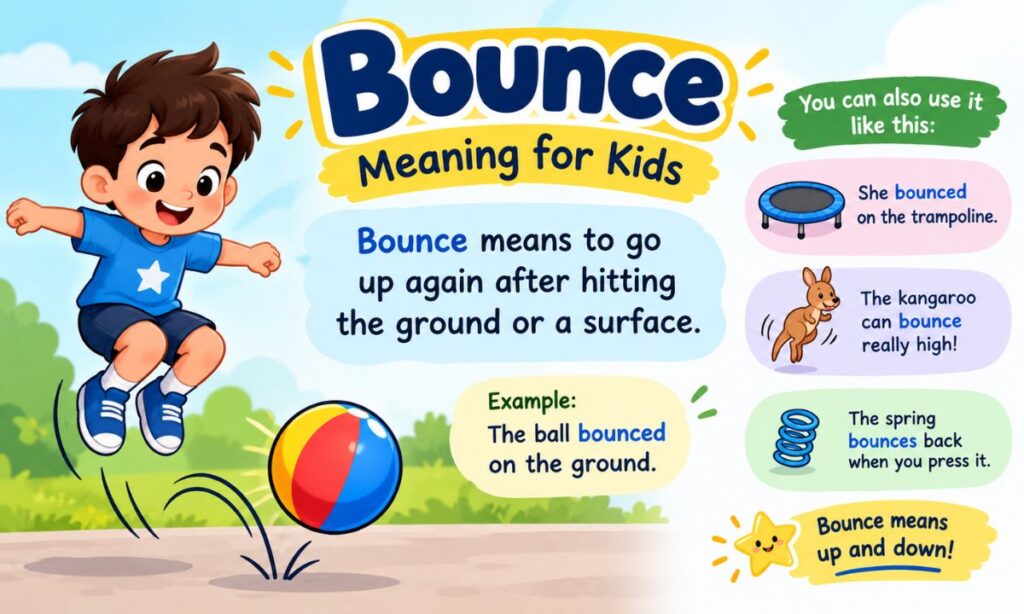
For young kids, “Bounce Meaning” means the springy movement of a ball or a trampoline. A ball bounces when it hits the ground and jumps back up.
Older kids and teens pick up the slang version at school and online. A simple way to explain it: “Bounce can mean jumping up and down, but when teens say ‘let’s bounce,’ they mean ‘let’s go.'”
Common Meanings of Bounce
1. Leave a Place
The most common slang use. Someone is simply departing.
- “It’s getting late, I’m gonna bounce.”
2. Go Somewhere Else
It can also mean switching locations, not just leaving.
- “This café is packed. Let’s bounce to the one down the street.”
3. Exit a Situation
It can mean stepping out of an awkward or boring moment.
- “The conversation got weird, so I bounced.”
4. Stop Participating
Sometimes it means dropping out of an activity, a group, or a game.
- “He bounced from the group project halfway through.”
| Meaning | Example | Feel |
| Leave a place | “I’m gonna bounce.” | Casual |
| Go elsewhere | “Let’s bounce to the mall.” | Plan-making |
| Exit a situation | “I bounced when it got awkward.” | Escape |
| Stop participating | “She bounced from the team.” | Dropping out |
“Let’s Bounce” Meaning
“Let’s Bounce Meaning” means “let’s leave” or “let’s go.” The speaker is suggesting that everyone head out together.
- “The line’s too long. Let’s bounce.”
- “Show’s over, let’s bounce.”
It’s friendly and works between peers. It’s not a good fit for formal settings.
“I Gotta Bounce” Meaning
“I gotta Bounce Meaning” means “I have to leave now.” “Gotta” is a casual contraction of “got to.”
- “Hey, I gotta bounce, my ride’s here.”
- “Gotta bounce, talk later.”
People often use it as a polite way to end a chat or call without a long explanation.
Bounce in Texting
In texts, “Bounce Meaning” usually announces a departure or a change of plans:
- “Bouncing in 5.”
- “Let’s bounce after lunch.”
- “He bounced already.”
It keeps messages short, which is why it’s popular in group chats. Be careful with tone, though. A lone “I’m bouncing” with no context can come across as abrupt.
Bounce in Social Media
Online, “bounce” often shows up in captions, comments, and stories:
- “This feed is chaos, I’m bouncing.”
- “Bounced from the app for a week.”
It can also describe leaving a platform, a livestream, or an argument.
Read our Blog on Meanvix
Bounce vs Leave
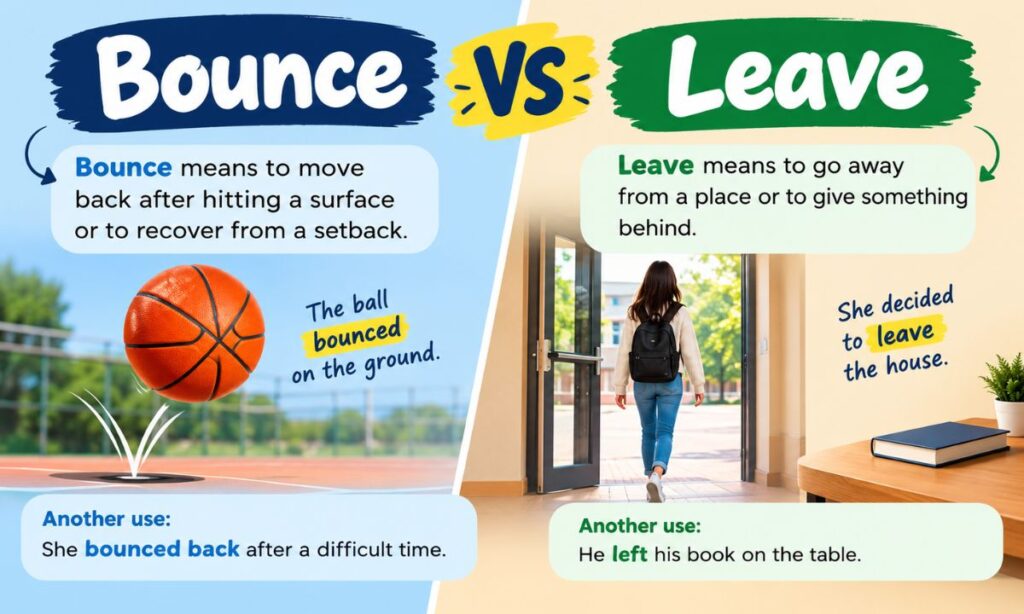
| Feature | Bounce | Leave |
| Tone | Casual, slangy | Neutral, standard |
| Formality | Informal | Works in any setting |
| Speed | Often implies a quick exit | No implied speed |
| Where used | Friends, texts, social media | Everywhere |
| Example | “I’m gonna bounce.” | “I’m going to leave.” |
Both mean the same thing at their core. “Leave” is the safe choice for work or school, and “bounce” fits friends.
Bounce vs Dip
| Feature | Bounce | Dip |
| Meaning | Leave a place | Leave quickly or suddenly |
| Vibe | Casual, planned or spontaneous | Often sudden, sometimes sneaky |
| Example | “Let’s bounce after dinner.” | “He dipped without saying bye.” |
“Dip” often suggests slipping away without being noticed. “Bounce” is more neutral and can be announced openly.
Bounce in Music & Hip-Hop
In music, “bounce” is about rhythm and groove. A beat that “has bounce” makes you want to move.
- “That track has so much bounce.”
- It also names a regional style: New Orleans bounce, a high-energy dance music known for call-and-response chants.
In hip-hop culture, the word also appears in lyrics and dance. A song might tell a crowd to “bounce,” meaning to move along with the beat.
Funny Examples of Bounce
Humor around “bounce” mostly comes from dramatic exits:
- The awkward exit: “He said something wild, and the entire table collectively bounced.”
- The social battery joke: “My social battery hit 2%, time to bounce.”
- The party reality: “Arrived at 8, bounced at 8:15.”
- The group chat: “Everyone’s saying they’re ‘five minutes away’ but nobody has bounced from the house yet.”
Can Bounce Mean Something Else?
Yes. Outside slang, “bounce” has many standard meanings:
- A ball rebounding: “The ball bounced twice.”
- Recovering: “She bounced back after the setback.” (“Bounce back” means recover.)
- Sharing ideas: “Let me bounce this idea off you.”
- A rejected check: “The check bounced.” (There wasn’t enough money in the account.)
- A returned email: “My message bounced back.” (It couldn’t be delivered.)
- Website bounce rate: the share of visitors who leave a site after viewing a single page.
- Removing someone: “The bouncer bounced him from the club.”
Context nearly always makes it obvious which one is meant.
Examples of Bounce in Sentences
Slang meaning (leaving):
- “I’m tired, I’m gonna bounce.”
- “We bounced right after the speech.”
- “Let’s bounce before the rain starts.”
Standard meanings:
4. “Her spirits bounced back quickly.”
5. “I’d like to bounce a few ideas off you.”
6. “The bank returned the bounced check.”
7. “The kids bounced on the trampoline all afternoon.”
Is Bounce Still Popular?
Yes. “Bounce” has been in casual speech for years and hasn’t faded. It’s stable, common slang, not a short-lived trend, and it’s easy for most age groups to understand. It also benefits from its many standard meanings, which keep the word in daily use.
Bounce in Everyday Conversations
You’ll hear it in lots of normal situations:
- At school: “Class is over, let’s bounce.”
- At work (casual): “I’m gonna bounce early today.”
- With family: “We should bounce soon, it’s late.”
- At events: “The music’s too loud. Wanna bounce?”
As a general rule, use “bounce” with friends and peers. In formal settings, say “leave” or “head out.”
Conclusion
“Bounce” started with the image of a ball rebounding, and today it often means “leave.” “Let’s bounce” and “I gotta bounce” are friendly, quick ways to announce a departure. The word also keeps its other meanings, from bounced checks to bouncing back, so context is the key to reading it correctly.
Use it in texts and with friends, and switch to “leave” when you need to sound formal.
FAQs
What does bounce mean in slang?
It means to leave a place quickly and casually.
What does “let’s bounce” mean?
It means “let’s leave” or “let’s go somewhere else.”
What does “I gotta bounce” mean?
It means “I have to leave now.”
Is “bounce” the same as “dip”?
They’re similar, but “dip” often suggests a sudden or unnoticed exit, while “bounce” can be announced.
What does bounce mean for kids?
For kids, it usually means jumping or a ball rebounding. Teens also use it to mean “leave.”
What does “bounce back” mean?
It means to recover quickly after a setback or problem.
What does a bounced check mean?
It means the bank rejected the check because the account didn’t have enough money.
What does “bounce an idea off someone” mean?
It means sharing an idea with someone to get their feedback.
Is “bounce” polite in texting?
It’s fine with friends, but it can feel abrupt without context, so add a quick reason.
Is “bounce” still used today?
Yes. It’s common, long-lasting slang that people of many ages understand.
